| Jungle Set ポケモンジャングル
Trading Card Game Set 2 |
||
| General information | ||
| Cards | English: 64 Japanese: 48 |
|
| Series | Original Series | |
| Region Focus | Kanto | |
| Previous Expansion | Base Set | |
| Following Expansion | Mystery of the Fossils | |
| Associated Decks |   Power Reserve Power Reserve   Water Blast Water Blast |
|
| Released | English: June 16, 1999 Japanese: March 5, 1997 |
|
| STD Legal Deck? | Yes | |

 The Jungle set was the second ever expansion of cards and theme decks for the Pokemon Trading Card Game. The set was initially released in Japan on March 5th, 1997 and didn’t get released in English until June 16th, 1999 over two years later when it finally arrived in the USA.
Jungle had actually been scheduled to release in the U.S as late as October of that year but due to Topps releasing their own Pokemon Cards earlier that summer WotC pushed release forward several months, it took only two weeks for the first edition print run of the Jungle set to sell out entirely. Jungle introduced new Pokémon to Trading Card form and introduced one new Trainer Card, PokéBall 64/64.
Despite Jungle being released in Japanese and English the Japanese set only contained 48 cards where the English set contained 64 – the reason behind this being that Wizards of the Coast decided to produce holo and non-holo versions of each of the rare cards, they did this for two reasons firstly to increase the size of the set in Western releases and secondly so they could guarantee a rare in every pack instead of a holo… hence you’d have to buy more booster packs to complete a set…. nice!
The pack artwork for the Jungle set’s Western boosters featured either; Flareon, Wigglytuff or Scyther where the Japanese booster packs artwork featured a group artwork of Mankey, Butterfree, Rhydon, Exeggutor, Paras, Oddish and Bellsprout. On the subject of Japanese artwork for this set, take a look at the Japanese Booster box art, it features an Exeggutor with a long neck….. a premonition of the Alolan Exeggutor from nearly two decades prior. Another point of note is that Jungle contained one solitary psychic Pokémon; Mr. Mime.
Can You Catch All the Jungle™ Cards?
Are you ready to explore the jungle? If you look hard, you’ll find 48 new Pokémon™® cards in the exciting Jungle expansion for the Pokémon trading card game. Trade with your friends, show off your favorites, and build decks from the random cards in this booster pack to customize a Pokémon theme deck or starter set.
Collect all the Jungle cards and you’ll discover awesome new holographic cards with super attacks—a must for every Pokémon collector!
Do you have the skills to become the world’s number-one Pokémon Master? Master the Pokémon trading card game and find out!
— Original Wizards of the Coast promotional copy, 1999
Print Versions & Collector’s info
The first print version of Jungle sold out rapidly after release. Those who bought boosters of the first print of the Jungle set had a chance of finding a very very rare 1st Edition Promotional Pikachu card which was said to be only found in 1 of 10 booster boxes – it goes without saying that these things are like gold dust now. The unlimited print run followed closely after the first print sold out, and early prints of many unlimited holo rares didn’t have their Jungle Set symbol on, these cards are now rather rare and collectible – they corrected the error in all of the print runs that followed.
Jungle followed Base Set to shelves in mid-1999. The English run shipped three booster wrapper arts — Wigglytuff, Flareon and Scyther — while Japan had its own pack and box art.
English booster packs


Japanese release


Set List
Here is the complete set list of 64 cards for the original English release Jungle set including all cards sorted by their numerical card number along with rarity and types.
| Card Image | No. | Card name | Rarity | Card type |
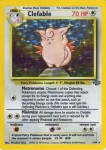 |
1/64 | Clefable |  |
 |
| Card text
Choose 1 of the Defending Pokémon’s attacks. Metronome copies that attack except for its Energy costs and anything else required in order to use that attack, such as discarding Energy cards. (No matter what type the Defending Pokémon is, Clefable’s type is still Colorless.)
|
||||
 |
2/64 | Electrode | |
 |
| Card text
If the Defending Pokémon isn’t Colorless, this attack does 10 damage to each Benched Pokémon of the same type as the Defending Pokémon (including your own).
|
||||
 |
3/64 | Flareon | |
 |
|
Card text
Flip a coin. If heads, this attack does 10 damage plus 20 more damage; if tails, this attack does 10 damage.
|
||||
 |
4/64 | Jolteon | |
|
|
Card text
Flip a coin. If heads, this attack does 10 damage plus 20 more damage; if tails, this attack does 10 damage.
|
||||
 |
5/64 | Kangaskhan | |
|
|
Card text
Flip 4 coins. This attack does 20 damage times the number of heads.
|
||||
 |
6/64 | Mr. Mime | |
|
|
Card text
Whenever an attack (including your own) does 30 or more damage to Mr. Mime (after applying Weakness and Resistance), prevent that damage. (Any other effects of attacks still happen.) This power can’t be used if Mr. Mime is Asleep, Confused, or Paralyzed.
|
||||
 |
7/64 | Nidoqueen | |
|
|
Card text
Does 20 damage plus 20 more damage for each Nidoking you have in play. |
||||
 |
8/64 | Pidgeot | |
|
|
Card text
Unless this attack Knocks Out the Defending Pokémon, return the Defending Pokémon and all cards attached to it to your opponent’s hand.
|
||||
 |
9/64 | Pinsir | |
|
|
Card text
Flip a coin. If heads, the Defending Pokémon is now Paralyzed. |
||||
 |
10/64 | Scyther | |
|
|
Card text
During your next turn, Scyther’s Slash attack’s base damage is 60 instead of 30.
|
||||
 |
11/64 | Snorlax | |
|
|
Card text
Snorlax can’t become Asleep, Confused, Paralyzed, or Poisoned. This power can’t be used if Snorlax is already Asleep, Confused, or Paralyzed.
|
||||
 |
12/64 | Vaporeon | |
|
|
Card text
Flip a coin. If heads, this attack does 10 damage plus 20 more damage; if tails, this attack does 10 damage.
|
||||
 |
13/64 | Venomoth | |
|
|
Card text
Once during your turn (before your attack), you may change the type of Venomoth to the type of any other Pokémon in play other than Colorless. This power can’t be used if Venomoth is Asleep, Confused, or Paralyzed.
|
||||
 |
14/64 | Victreebel | |
|
|
Card text
If your opponent has any Benched Pokémon, choose 1 of them and switch it with his or her Active Pokémon.
|
||||
 |
15/64 | Vileplume | |
|
|
Card text
Once during your turn (before your attack), you may flip a coin. If heads, remove 1 damage counter from 1 of your Pokémon. This power can’t be used if Vileplume is Asleep, Confused, or Paralyzed.
|
||||
 |
16/64 | Wigglytuff | |
|
|
Card text
The Defending Pokémon is now Asleep.
|
||||
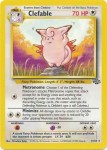 |
17/64 | Clefable |  |
|
|
Card text
Choose 1 of the Defending Pokémon’s attacks. Metronome copies that attack except for its Energy costs and anything else required in order to use that attack, such as discarding Energy cards. (No matter what type the Defending Pokémon is, Clefable’s type is still Colorless.)
|
||||
 |
18/64 | Electrode | |
|
|
Card text
If the Defending Pokémon isn’t Colorless, this attack does 10 damage to each Benched Pokémon of the same type as the Defending Pokémon (including your own).
|
||||
 |
19/64 | Flareon | |
|
|
Card text
Flip a coin. If heads, this attack does 10 damage plus 20 more damage; if tails, this attack does 10 damage
|
||||
 |
20/64 | Jolteon | |
|
|
Card text
Flip a coin. If heads, this attack does 10 damage plus 20 more damage; if tails, this attack does 10 damage.
|
||||
 |
21/64 | Kangaskhan | |
|
|
Card text
Flip 4 coins. This attack does 20 damage times the number of heads.
|
||||
 |
22/64 | Mr. Mime | |
|
|
Card text
Whenever an attack (including your own) does 30 or more damage to Mr. Mime (after applying Weakness and Resistance), prevent that damage. (Any other effects of attacks still happen.) This power can’t be used if Mr. Mime is Asleep, Confused, or Paralyzed.
|
||||
 |
23/64 | Nidoqueen | |
|
|
Card text
Does 20 damage plus 20 more damage for each Nidoking you have in play.
|
||||
 |
24/64 | Pidgeot | |
|
| Card text
Unless this attack Knocks Out the Defending Pokémon, return the Defending Pokémon and all cards attached to it to your opponent’s hand.
|
||||
 |
25/64 | Pinsir | |
|
|
Card text
Flip a coin. If heads, the Defending Pokémon is now Paralyzed.
|
||||
 |
26/64 | Scyther | |
|
|
Card text
During your next turn, Scyther’s Slash attack’s base damage is 60 instead of 30.
|
||||
 |
27/64 | Snorlax | |
|
|
Card text
Snorlax can’t become Asleep, Confused, Paralyzed, or Poisoned. This power can’t be used if Snorlax is already Asleep, Confused, or Paralyzed.
|
||||
 |
28/64 | Vaporeon | |
|
|
Card text
Flip a coin. If heads, this attack does 10 damage plus 20 more damage; if tails, this attack does 10 damage.
|
||||
 |
29/64 | Venomoth | |
|
|
Card text
Once during your turn (before your attack), you may change the type of Venomoth to the type of any other Pokémon in play other than Colorless. This power can’t be used if Venomoth is Asleep, Confused, or Paralyzed.
|
||||
 |
30/64 | Victreebel | |
|
|
Card text
If your opponent has any Benched Pokémon, choose 1 of them and switch it with his or her Active Pokémon.
|
||||
 |
31/64 | Vileplume | |
|
|
Card text
Once during your turn (before your attack), you may flip a coin. If heads, remove 1 damage counter from 1 of your Pokémon. This power can’t be used if Vileplume is Asleep, Confused, or Paralyzed.
|
||||
 |
32/64 | Wigglytuff | |
|
|
Card text
Does 10 damage plus 10 more damage for each of your Benched Pokémon.
|
||||
 |
33/64 | Butterfree |  |
|
|
Card text
If your opponent has any Benched Pokémon, he or she chooses 1 of them and switches it with the Defending Pokémon. (Do the damage before switching the Pokémon.)
|
||||
 |
34/64 | Dodrio | |
|
|
Card text
As long as Dodrio is Benched, pay less to retreat your Active Pokémon.
|
||||
 |
35/64 | Exeggutor | |
|
|
Card text
Switch Exeggutor with 1 of your Benched Pokémon.
|
||||
 |
36/64 | Fearow | |
|
|
Card text
Flip a coin. If heads, during your opponent’s next turn, prevent all effects of attacks, including damage, done to Fearow.
|
||||
 |
37/64 | Gloom | |
|
|
Card text
Both the Defending Pokémon and Gloom are now Confused (after doing damage).
|
||||
 |
38/64 | Lickitung | |
|
|
Card text
Flip a coin. If heads, the Defending Pokémon is now Paralyzed.
|
||||
 |
39/64 | Marowak | |
|
|
Card text
Flip 2 coins. This attack does 30 damage times the number of heads.
|
||||
 |
40/64 | Nidorina | |
|
|
Card text
Flip a coin. If heads, the Defending Pokémon is now Confused.
|
||||
 |
41/64 | Parasect | |
|
|
Card text
The Defending Pokémon is now Asleep.
|
||||
 |
42/64 | Persian | |
|
|
Card text
If the Defending Pokémon attacks Persian during your opponent’s next turn, any damage done by the attack is reduced by 10 (after applying Weakness and Resistance).(Benching either Pokémon ends this effect.)
|
||||
 |
43/64 | Primeape | |
|
|
Card text
Flip 3 coins. This attack does 20 damage times the number of heads.
|
||||
 |
44/64 | Rapidash | |
|
|
Card text
Flip a coin. If heads, this attack does 20 damage plus 10 more damage; if tails, this attack does 20 damage.
|
||||
 |
45/64 | Rhydon | |
|
|
Card text
Rhydon does 20 damage to itself. If your opponent has any Benched Pokémon, he or she chooses 1 of them and switches it with the Defending Pokémon. (Do the damage before switching the Pokémon. Switch the Pokémon even if Rhydon is knocked out.)
|
||||
 |
46/64 | Seaking | |
|
|
Card text
Horn Attack
|
||||
 |
47/64 | Tauros | |
|
|
Card text
Flip a coin. If heads, this attack does 20 damage plus 10 more damage; if tails, this attack does 20 damage.
|
||||
 |
48/64 | Weepinbell | |
|
|
Card text
Flip a coin. If heads, the Defending Pokémon is now Poisoned. |
||||
 |
49/64 | Bellsprout |  |
|
|
Card text
Search your deck for a Basic Pokémon named Bellsprout and put it onto your Bench. Shuffle your deck afterward. (You can’t use this attack if your Bench is full.)
|
||||
 |
50/64 | Cubone | |
|
|
Card text
If the Defending Pokémon attacks Cubone during your opponent’s next turn, any damage done by the attack is reduced by 20 (after applying Weakness and Resistance). (Benching either Pokémon ends this effect.)
|
||||
 |
51/64 | Eevee | |
|
|
Card text
If the Defending Pokémon attacks Cubone during your opponent’s next turn, any damage done by the attack is reduced by 20 (after applying Weakness and Resistance). (Benching either Pokémon ends this effect.)
|
||||
 |
52/64 | Exeggcute | |
|
|
Card text
Unless all damage from this attack is prevented, you may remove 1 damage counter from Exeggcute.
|
||||
 |
53/64 | Goldeen | |
|
|
Card text
Horn Attack
|
||||
 |
54/64 | Jigglypuff | |
|
|
Card text
The Defending Pokémon is now Asleep.
|
||||
 |
55/64 | Mankey | |
|
|
Card text
Once during your turn (before your attack), you may look at one of the following: the top card of either player’s deck, a random card from your opponent’s hand, or one of either player’s Prizes. This power can’t be used if Mankey is Asleep, Confused, or Paralyzed.
|
||||
 |
56/64 | Meowth | |
|
|
Card text
Flip a coin. If heads, draw a card.
|
||||
 |
57/64 | Nidoran♀ | |
|
|
Card text
Flip 3 coins. This attack does 10 damage times the number of heads.
|
||||
 |
58/64 | Oddish | |
|
|
Card text
Flip a coin. If heads, the Defending Pokémon is now Paralyzed.
|
||||
 |
59/64 | Paras | |
|
|
Card text
The Defending Pokémon is now Asleep.
|
||||
 |
60/64 | Pikachu | |
|
|
Card text
If your opponent has any Benched Pokémon, choose 1 of them and this attack does 10 damage to it. (Don’t apply Weakness and Resistance for Benched Pokémon.)
|
||||
 |
61/64 | Rhyhorn | |
|
|
Card text
Flip a coin. If heads, the Defending Pokémon can’t attack Rhyhorn during your opponent’s next turn. (Benching either Pokémon ends this effect.)
|
||||
 |
62/64 | Spearow | |
|
|
Card text
If Spearow was attacked last turn, do the final result of that attack on Spearow to the Defending Pokémon.
|
||||
 |
63/64 | Venonat | |
|
|
Card text
Flip a coin. If heads, the Defending Pokémon is now Paralyzed.
|
||||
 |
64/64 | Poké Ball | |
T |
|
Card text
Flip a coin. If heads, you may search your deck for any Basic Pokémon or Evolution card. Show that card to your opponent, then put it into your hand. Shuffle your deck afterward.
|
||||
Other Cards
Beyond the 64 cards in the main set, a handful of Jungle cards exist in forms you will not find in a booster pack. Some were distributed through promotions and never sold at retail; others are printing errors that Wizards of the Coast corrected mid-run, leaving two distinct versions in circulation. All of them are worth recognising before you value a card.
Promotional and alternate printings
| No. | Card | What makes it different |
|---|---|---|
| 1/64 | Clefable |
Issued as a Pokémon League and Prerelease promo, separate from the retail holo printing. |
| 56/64 | Meowth |
A gold-bordered version given away as a Pokémon Rolls food-product exclusive — one of the more obscure distributions of the era. |
| 60/64 | Pikachu |
Reissued with the gold W stamp through The Duelist magazine in September 1999. |
Corrected error cards
These two were fixed part-way through printing, so both the flawed and corrected versions exist. The errors are subtle — check carefully rather than assuming.
| No. | Card | The error |
|---|---|---|
| 33/64 | Butterfree |
The 1st Edition stamp reads as “Edition d” — what should be a 1 renders as a lowercase d. |
| 63/64 | Venonat |
A dark line across the top left, where the green background meets the yellow border. |
The No Symbol holos
Separately from the two corrected errors above, a number of Unlimited holographic Jungle cards were printed without the Jungle set symbol altogether. These are the set’s best-known variants, and they make Jungle the only expansion besides Base Set where a card can legitimately carry no set symbol at all. Because Base Set never had one, a symbol-less holo is easy to misidentify — check the card number and copyright line to place it.
For Collectors: Most Valuable Cards
Jungle was printed in vast quantities at the height of the 1999 Pokémon boom, which keeps the set unusually affordable for something this historically important. A complete 64-card Unlimited run is one of the easiest vintage sets to finish. The money sits in three places: 1st Edition printings, high-grade holos, and the set’s well-documented misprints.
1st Edition Jungle sold out within weeks of release, so 1st Edition cards are meaningfully scarcer than Unlimited — and arguably scarcer than a good deal of Unlimited Base Set, while often being priced as though they matter less. That gap is the most interesting thing about Jungle as a collecting target.
Snorlax (11/64)
Consistently the most in-demand holo in the set. Snorlax’s enduring popularity as a character does most of the work, and 1st Edition copies in high grade are Jungle’s headline cards.
Flareon (3/64), Jolteon (4/64) and Vaporeon (12/64)
Jungle gave the Eeveelutions their first Pokémon TCG appearance, and demand for the trio has never really faded. Many collectors chase all three together, which spreads value across the group rather than concentrating it in one card.
Scyther (10/64)
A rare case of a card that is both a collector favourite and a genuine competitive staple (see below). Demand from players and collectors at the same time keeps it near the top of the set.
Electrode (2/64)
Notable beyond its playability because of the Base Set art error — some copies carry artwork from the Base Set Electrode. Error hunters treat this as one of Jungle’s key variants.
Mr. Mime (6/64)
Mr. Mime’s price has always been supported by how feared Invisible Wall was in 1999 tournament play. It is a good example of a card whose value is a fossil record of the format it was printed into.
The error cards
Three misprints matter most. The No Symbol holos — Unlimited holographic cards accidentally printed without the Jungle set symbol — are the famous one, and they make Jungle the only expansion besides Base Set where a card can legitimately lack a set symbol. The Butterfree “d” Edition error shows what looks like a lowercase d in place of the 1 in the 1st Edition stamp. The Venonat error carries a dark line where the green background meets the yellow border. All three are worth checking for before writing off a bulk lot.
Values in vintage Pokémon move constantly. Treat any quoted figure as directional and check live sold comps before buying or selling.
Most Powerful Cards (Competitive Play)
Jungle is the set that broke the Base Set format open. Before it, Haymaker was more or less unchallenged. Jungle gave the format its first serious alternative and forced Haymaker itself to change shape.
Wigglytuff (16/64)
The most important competitive card in the set. Do the Wave dealt 10 damage for each Pokémon on your Bench, reaching 60 with a full Bench — and 70 with a PlusPower, exactly enough to one-hit-KO Hitmonchan, Electabuzz and Scyther, the three most common attackers in the format. Because it ran on Double Colorless Energy it also held up far better against Energy Removal and Super Energy Removal than most heavy hitters. Wigglytuff decks became one of the two dominant archetypes after Jungle’s release.
Scyther (10/64)
A free retreat cost and the ability to attack from turn two off Double Colorless Energy made Scyther an immediate Haymaker upgrade. The classic trio shifted from Hitmonchan / Electabuzz / Farfetch’d to Hitmonchan / Electabuzz / Scyther, and Scyther’s Fighting resistance made life awkward for the Fighting attackers that had been dominating.
Mr. Mime (6/64)
Invisible Wall prevented damage from attacks doing 30 or more — which, in a format built on big single hits, read as “you cannot damage me” to several top decks. Rain Dance in particular had limited ways through it. Haymaker and Damage Swap could route around it, but Mr. Mime warped deckbuilding for everyone else.
Kangaskhan (5/64)
Fetch drew a card for a single Colorless Energy, and 90 HP meant Kangaskhan survived long enough to do it repeatedly. It became the standard opening Pokémon for decks that needed time to assemble Stage 1 and Stage 2 lines.
Electrode (2/64)
Buzzap turned Electrode itself into a Double Colorless Energy attached to another Pokémon — real acceleration, at the cost of knocking itself out. Powerful, high-risk, and a card that rewarded players who could count prizes.
Trivia & Pop Culture
- Jungle is set in the Kanto Safari Zone, which is why the roster leans so heavily on Pokémon you would actually find there.
- The set symbol is a stylised flower widely read as a Vileplume.
- The Japanese release (Pokémon Jungle, 5 March 1997) had only 48 cards. Wizards of the Coast expanded the English set to 64 by printing every holo rare a second time as a non-holo — holos run 1–16, their non-holo twins 17–32. This stopped every pack guaranteeing a holo, and set a convention that Fossil, Team Rocket, Neo Discovery and the e-Card sets all followed. Players at the time were not universally impressed, arguing it padded the set without adding anything new.
- Of the 64 cards, 45 were Pokémon making their TCG debut. Two — Electrode and Pikachu — were Base Set Pokémon reprinted with new powers, and there was exactly one Trainer: Poké Ball (64/64).
- The 1st Edition print run accidentally included copies of the extremely rare 1st Edition Promo Pikachu.
- Pikachu 60/64 was reissued in September 1999 as a promo with a gold “W” stamp, distributed through The Duelist magazine.
- The Dutch, German, French, Italian, Spanish and Portuguese releases all landed in February 2000, roughly eight months behind English.
- Jungle gave the Eeveelutions — Flareon, Jolteon and Vaporeon — their first appearance in the Pokémon Trading Card Game.
Images & Videos
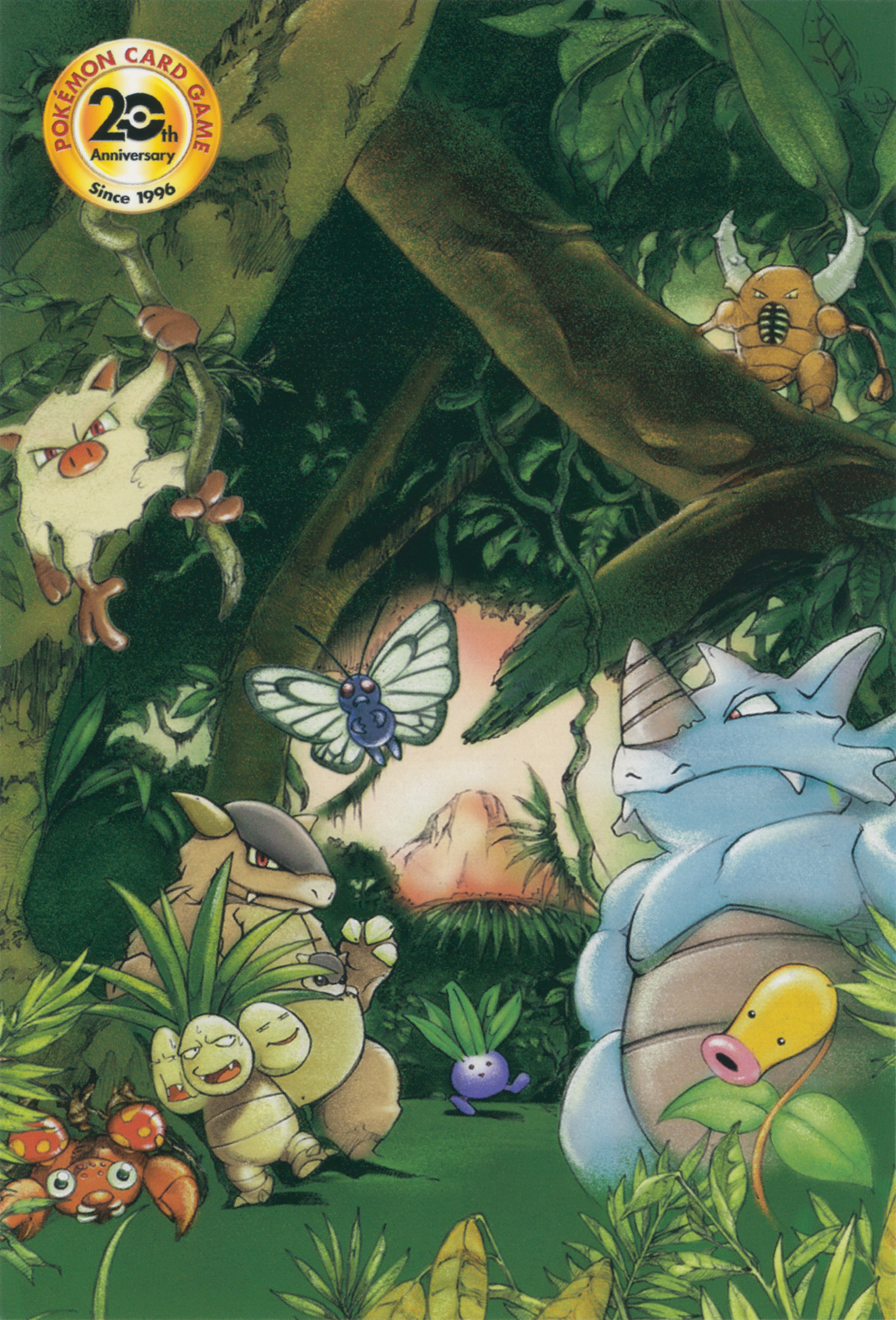

A collection of media relating to the Jungle Set of the Pokemon TCG including booster pack and box art, promotional posters as well as TV commercials and other videos. Of particular note here is the Exeggutor with the long neck on the Japanese booster box – a premonition of the Alolan form Exeggutor decades prior to it being unveiled in the Pokémon Sun & Moon videogames.


