  |
|
| Titles | Pokémon Box: Ruby & Sapphire ポケモンボックス ルビー&サファイア (Pokémon Bokkusu Rubī ando Safaia) |
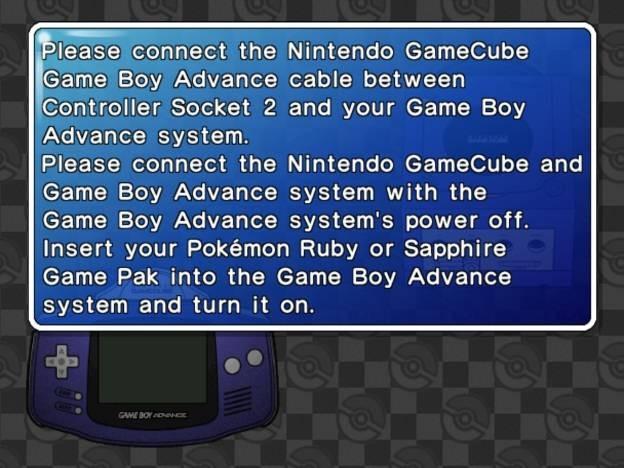
| Platform | Nintendo GameCube (Memory Card 59, GameCube–GBA cable and a Generation III cartridge needed) |
| Developer | Nintendo, with Game Freak |
| Publisher | The Pokémon Company (Japan) · Nintendo (elsewhere) |
| Producers | Shigeru Miyamoto · Kenji Miki |
| Players | Single player |
| Genre | Utility – Pokémon storage and management |
| Storage | 25 Boxes of 60 – up to 1,500 Pokémon |
| Released | 30 May 2003 (Japan) · 14 May 2004 (Europe, in the Pokémon Colosseum Mega Pak) · 11 July 2004 (North America, Pokémon Center exclusive) · 16 July 2004 (Australia) |
| Re-releases | None – not on Nintendo Switch Online (October 2026) |
| Rating | ESRB E · PEGI 3 · CERO All ages · OFLC G8+ |
| Successor | My Pokémon Ranch (WiiWare, 2008) |
Overview
 Pokémon Box: Ruby & Sapphire is a spin-off game released on the GameCube that is more of a companion tool to be used with the third-generation games than an actual game. It is probably one of the rarest Pokémon games, due to its limited release and the few ways one can get a copy. In fact, in North America it was only released in New York’s Pokémon Center and its online store.
In Europe, the game came as a bonus disc in the Pokémon Colosseum Mega Pak, and a limited number of standalone copies could be obtained with points from Nintendo’s European loyalty programme, the Stars Catalogue. Due to its extreme rarity, a used North American copy now costs well over a thousand US dollars. As stated earlier, Pokémon Box: Ruby & Sapphire is mainly a storage system hosted by Brigette, older sister of Lanette, the PC storage system host in the Hoenn region. Linking it to the third-generation Pokémon games (Ruby, Sapphire, Emerald, LeafGreen and FireRed) gives access to many useful features, such as a very big Pokémon storage, extra Pokémon Eggs and a Showcase mode. Similar Pokémon games were released afterwards, such as My Pokémon Ranch on the Nintendo Wii, Pokémon Bank on the 3DS and, today, Pokémon HOME.
This unique device for Nintendo GameCube is an extension of the Pokédex found in the Game Boy Advance games Pokémon Ruby and Pokémon Sapphire. It gives players a truly interactive experience, allowing them to display, organise and store all Pokémon captured in Pokémon Ruby and Pokémon Sapphire in structured, full 3D format on the big screen. Players can play Pokémon Ruby and Pokémon Sapphire on the big screen through the Pokémon Box without using a Game Boy Player. Players can also take pictures from Pokémon Ruby and Pokémon Sapphire and use them as background images on their Pokémon Box. This is an all new, never seen before feature!
— Official description (Nintendo of Europe, April 2004)
Quick Answers
The questions people ask about Pokémon Box: Ruby & Sapphire, answered first and explained further down the page.
How many Pokémon can Pokémon Box hold?
Up to 1,500. The storage is split into 25 Boxes with 60 slots each, more than three times the 426 Pokémon that Ruby or Sapphire can carry between the party and the PC. All that data fills a whole Memory Card 59, and the larger Memory Card 251 is not supported at all. More →

Which Game Boy Advance games work with Pokémon Box?
The storage side works with Ruby, Sapphire, FireRed, LeafGreen and Emerald, each with its own unlock: the Pokédex in Ruby and Sapphire, Hall of Fame data plus the National Pokédex in Emerald, and the finished Sevii Islands quest with Hoenn trading switched on in FireRed and LeafGreen. The game must be saved at a Pokémon Center first. More →
How do you get all four bonus Eggs?
Brigette gives a Swablu Egg with False Swipe when you first deposit Pokémon, then a Zigzagoon Egg with ExtremeSpeed once 100 Pokémon are stored, a Skitty Egg with Pay Day at 500 and a Pichu Egg with Surf at 1,499, the Egg itself taking the final slot. Each save file can claim every Egg once. More →
Can Pokémon Box play Emerald, FireRed or LeafGreen on the TV?
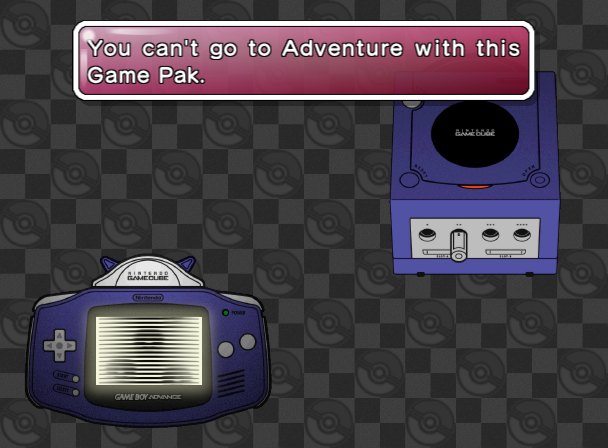
No. The Go to Adventure option only runs Ruby and Sapphire, which are stored on the disc and use the save on the connected cartridge; FireRed, LeafGreen and Emerald bring up an error screen instead. Those three can still use the storage side of Pokémon Box, and the Game Boy Player add-on runs them on a television. More →
Why is Pokémon Box so rare and expensive?
In North America it was only ever sold at the Pokémon Center store in New York and on the Pokémon Center website, and in Europe it mostly came packed inside the Pokémon Colosseum Mega Pak. By October 2026 loose North American discs were selling for around US$1,500, while common Japanese copies cost a small fraction of that. More →
Can you still use Pokémon Box today, and is it on Nintendo Switch Online?
It has never been re-released and is not on Nintendo Switch Online. You need original hardware: a GameCube or a GameCube-compatible Wii, a Memory Card 59, a Game Boy Advance, the GameCube to Game Boy Advance cable and a Generation III cartridge. A Japanese disc will not recognise English-language cartridges, so match your regions. More →
Features

Brigette, your host
Brigette is the older sister of Lanette, who developed the standard PC storage system together with Bill. She designed the mass storage system behind Pokémon Box, upgrading it to hold 1,500 Pokémon and to move several at once, and she hands out the bonus Eggs from her room. Her Japanese name is Azusa, and her artwork is by Ken Sugimori. She later returned as the keeper of Pokémon Bank on the Nintendo 3DS.
Pokémon Box: Ruby & Sapphire mainly offers four fundamental features:
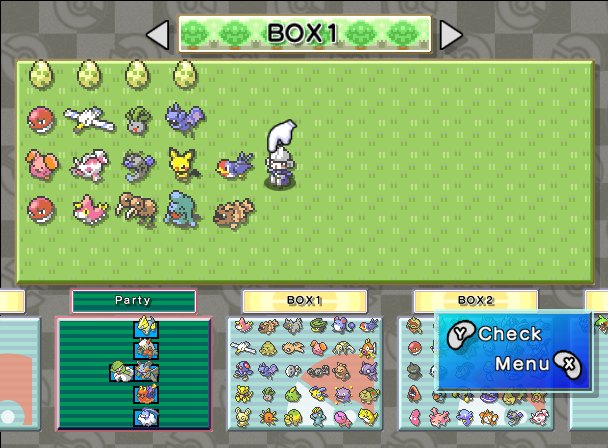
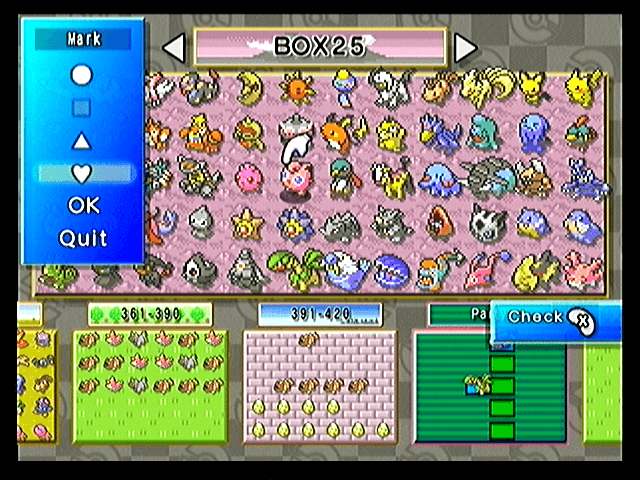
The Storage Box: It is the main feature of the game and the most important one. There are 25 boxes available, in which players can store their Pokémon from the third-generation games. Each box can store up to 60 Pokémon, which means up to 1,500 Pokémon can be stored in total. Within the boxes there are some fun options the player can select. The game allows the transfer of several Pokémon at once. Players can set a unique background for each box, including a screenshot of their game, which they can take with the Adventure Mode. Boxes can also be renamed. It is important to note that certain conditions have to be met within each of the third-generation games before the player can transfer their Pokémon to or from Pokémon Box – starting with saving the game at a Pokémon Center. The conditions are as follows:
- Pokémon Ruby and Pokémon Sapphire: Before being able to put any Pokémon into Pokémon Box, the player must first acquire the Pokédex from Professor Birch. Additionally, to be able to retrieve Pokémon the player didn’t deposit from Ruby or Sapphire into Pokémon Box, they must have at least 100 Pokémon caught in their Pokédex.
- Pokémon Emerald: Before being able to deposit Pokémon in Pokémon Box, the player must have entered the Hall of Fame and received the National Pokédex. At least 100 Pokémon must be caught and shown in the Pokédex to be able to withdraw Pokémon they didn’t transfer from Pokémon Emerald to Pokémon Box.
- Pokémon FireRed and Pokémon LeafGreen: Transferring Pokémon into and from the game requires that the player finishes the Sevii Islands quest and activates the trade option with the games of the Hoenn region (Pokémon Ruby & Sapphire). Additionally, there’s another withdrawal condition, which is to catch 100 Pokémon, just like the other third-generation games.
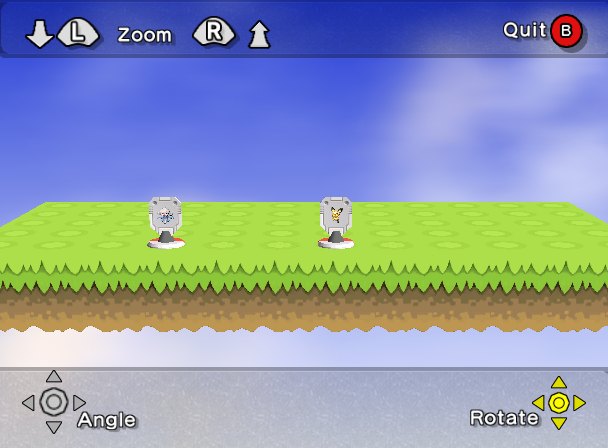
Pokémon Showcase Mode: This mode lets the player display different figurines with Pokémon drawn on them on a variety of backgrounds. As with the Storage Box, the player can change the background, its music and its name. They are also able to adjust both the background’s and the figurines’ shapes and sizes.

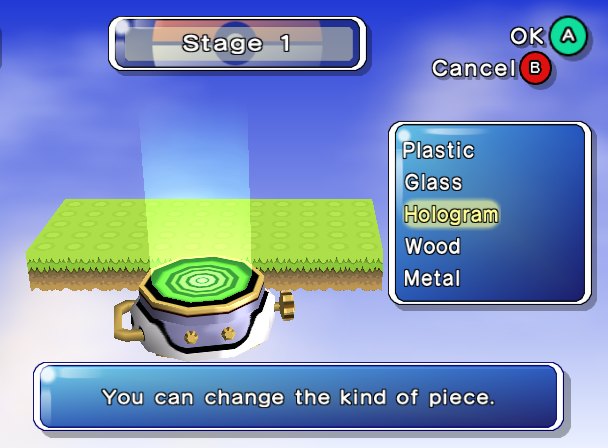
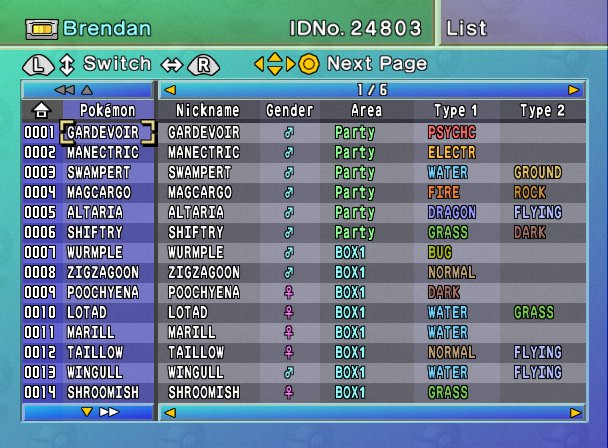
Pokémon Stats Preview: It is possible for the user to view detailed information about the Pokémon stored in Pokémon Box: Ruby & Sapphire and those stored in the game currently linked to the GameCube. The details even include the ribbons won by the Pokémon, which helps tell a Pokémon apart from its lookalikes.
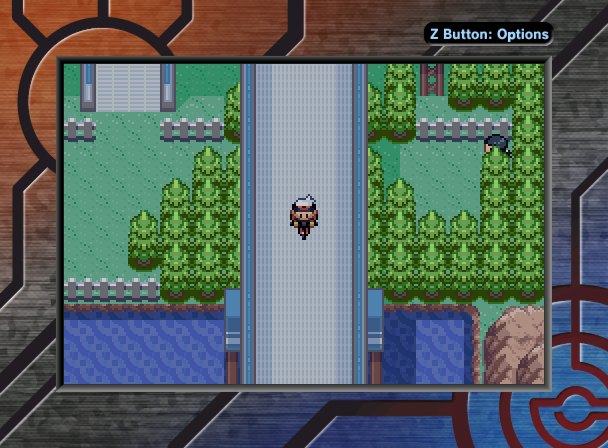
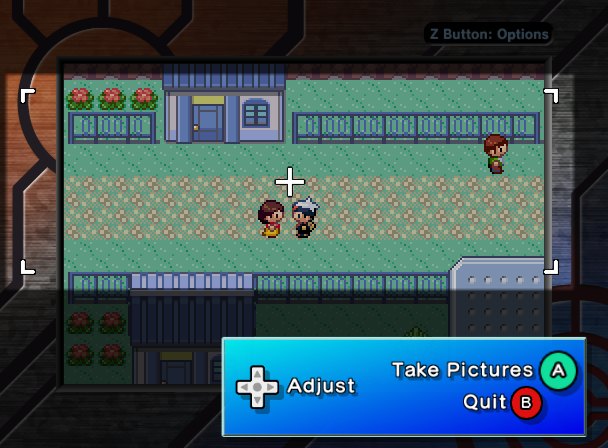
The Adventure Mode: It basically allows the GBA third-generation games Pokémon Ruby and Pokémon Sapphire to be played on the big screen (Pokémon LeafGreen, FireRed and Emerald can’t be played this way). What’s special about it is that it comes with a screenshot feature, Take Pictures, that allows the player to capture the current game moment and use it as a box background.
In depth: the fine print

How it interacts with other Pokémon titles
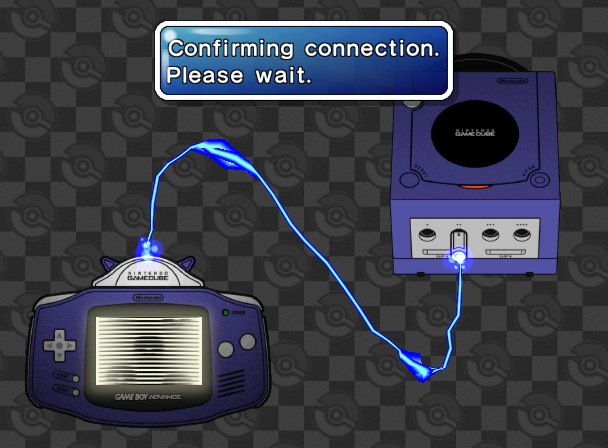
The game was mainly conceived to work with Pokémon Ruby and Pokémon Sapphire – FireRed, LeafGreen and Emerald didn’t even exist yet when it launched in Japan – but it can also be linked to Pokémon Emerald, Pokémon FireRed and Pokémon LeafGreen. As mentioned above, it mainly allows Pokémon players to store their Pokémon from these games, using stylish and fun methods of display.
Bonus Eggs
Aside from its unique features, Pokémon Box: Ruby & Sapphire also offers its players Bonus Eggs as a gift. These Eggs can be obtained after reaching a certain number of stored Pokémon in the game. They can then be transferred to the other Pokémon games, where they are hatched in the usual way (walking around while having the Egg in the player’s current team). Each Egg contains a different Pokémon, but with a unique move that it can’t normally learn, which makes the Eggs worth the effort.
 SwabluFalse Swipe
 ZigzagoonExtremeSpeed
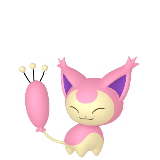 SkittyPay Day
 PichuSurf
- First Egg: The first Egg contains a Swablu that knows the special move False Swipe. It is earned as a reward for making your first deposit.
- Second Egg: The second Egg contains a Zigzagoon with the special move ExtremeSpeed. It is earned upon reaching 100 stored Pokémon.
- Third Egg: The third one contains a Skitty that has learned the special move Pay Day. It is the reward for reaching 500 stored Pokémon.
- Fourth Egg: Probably the hardest one to get, which requires far more effort breeding and catching Pokémon to store in the game. It hatches into a Pichu with Surf and is the final reward for reaching 1,499 stored Pokémon (the Egg itself takes the 1,500th slot).
Each Game Boy Advance save file can collect one of each Egg, the Pokémon hatch at level 5, and their special moves can’t be passed on by breeding.
Getting hold of a copy
Pokémon Box was sold in a different way in almost every region, which is why prices for it vary so wildly today:
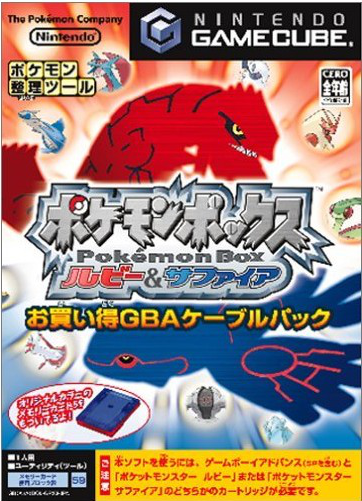
- Japan had an ordinary shop release on 30 May 2003 in two packs: the disc with a Memory Card 59 at ¥1,905 before tax, and a version adding the GameCube to Game Boy Advance cable at ¥2,667 before tax.
- North America received it on 11 July 2004 only through Pokémon Center New York and the Pokémon Center website, packaged with the special Ruby and Sapphire Memory Card 59 and the link cable.
- Europe received it on 14 May 2004 as a bonus disc in the Pokémon Colosseum Mega Pak, alongside a memory card and the link cable, and in limited numbers through Nintendo of Europe’s Stars Catalogue; that standalone copy came with an ordinary memory card and no cable.
- Australia’s PAL release followed on 16 July 2004.
In October 2026 the North American edition was changing hands for roughly US$1,500 loose and US$2,400 complete in its box, with sealed copies above US$2,800 – one of the most expensive GameCube games of all. PAL copies sell for around US$140 to US$180, and Japanese copies, which only work with Japanese cartridges, for as little as US$20 to US$50.

Regional Variations
- Japanese copies were bundled with a bonus disc holding a Viewtiful Joe demo plus screens and movies of Final Fantasy Crystal Chronicles and Tales of Symphonia.
- The Japanese disc does not recognise saves from English-language cartridges, so importers also need a Japanese copy of Ruby or Sapphire.
- European versions use translated titles: Pokémon Box Rubin & Saphir (German), Pokémon Box Rubis & Saphir (French), Pokémon Box Rubino e Zaffiro (Italian) and Pokémon Box Rubí y Zafiro (Spanish). The name Pokémon Memory Magic was planned for some territories but dropped.
- Brigette is called Azusa in Japanese, Linette in German, Juliette in French, Colette in Italian and Nereida in Spanish.
Glitches, exploits and oddities
Two quirks of Adventure Mode:
Adventure Mode cartridge error
Although FireRed, LeafGreen and Emerald can all deposit and withdraw Pokémon, choosing Go to Adventure with one of those cartridges connected only produces an error screen. The emulation side of Pokémon Box was built around Ruby and Sapphire, which are stored on the disc itself and simply borrow the cartridge’s save, so the later Generation III games have nothing to run. The result is a cartridge that is welcome in the storage menu but turned away one option further down the same title screen.
Two separate PCs in Adventure Mode
While playing Ruby or Sapphire through Go to Adventure, switching on the in-game PC only shows the Boxes saved on the cartridge. None of the 1,500 slots on the memory card can be reached from inside the adventure, even though the GameCube is running both halves of the software at once. Players who want to swap Pokémon between their journey and the big storage have to save, leave the adventure and use Go to Pokémon Box from the title menu instead.
Videos & media
Check out these videos relating to Pokémon Box: Ruby & Sapphire, including commercials, trailers and gameplay.
A Japanese TV commercial for Pokémon Box: Ruby & Sapphire.
The E3 2003 gameplay trailer.
A good-quality video showing some of the features in Pokémon Box RS, by ShadowMario3.
Trivia & facts
-

Brigette as she appears in Pokémon Bank. Brigette reappears in Pokémon Bank for the 3DS, as the person who maintains the service.
- It is possible to transfer Pokémon from Pokémon Colosseum and Pokémon XD: Gale of Darkness. This can’t be done directly, but first by transferring Pokémon from those two games to one of the third-generation games, and then to Pokémon Box. As the Pokémon are actually ‘transferred’ and not traded to Pokémon Box, Pokémon that would evolve upon trading won’t.
- There are many rumours saying that the game can’t be linked to Pokémon Emerald, although its storage works with all the third-generation games – the confusion probably comes from Adventure Mode, which doesn’t support Emerald.
- The name Pokémon Memory Magic was planned for some European territories, but it was dropped and the European versions kept the Pokémon Box name.
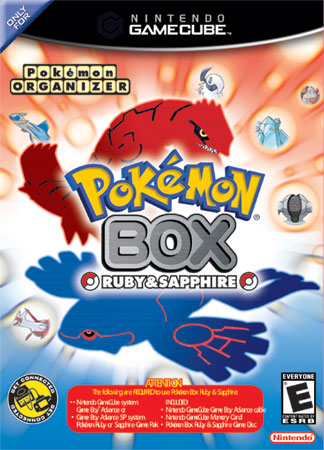
- An Absol is featured on the box art of the North American version of the game – the only non-Legendary Pokémon on it.
Further trivia
- It was the first Pokémon game released on the GameCube, arriving in Japan on 30 May 2003, ahead of Pokémon Channel and Pokémon Colosseum.
- Most editions include a special red-and-blue Ruby and Sapphire Memory Card 59; the standalone European copy came with a plain memory card and no link cable instead.
- Only the Memory Card 59 is supported, not the larger Memory Card 251, and Pokémon Box needs every one of its 59 blocks.
- Ruby and Sapphire can hold at most 426 Pokémon between the party and the PC, so Pokémon Box more than triples a single cartridge’s capacity.
- Brigette’s Japanese name, Azusa, comes from a tree name that is also a regional word for the winged spindle, matching Bill, Lanette and Celio, whose Japanese names are all drawn from spindle-tree plants.
- The Adventure Mode border depends on the player character: a metallic red-and-blue frame for Brendan, or a gold frame topped with the silhouettes of Treecko, Torchic and Mudkip for May.
- Pokémon Center New York, the only bricks-and-mortar shop in North America to stock it, closed on 19 January 2005, about six months after Pokémon Box went on sale there.
Legacy
What came after
- Japanese launch – 30 May 2003. Ordinary retail release in two packs, with or without the GBA cable
- European launch in the Pokémon Colosseum Mega Pak – 14 May 2004. Bonus disc alongside Colosseum, a memory card and the link cable; a limited standalone run followed through the Stars Catalogue
- North American launch – 11 July 2004. Sold only at Pokémon Center New York and on the Pokémon Center website
- Australian launch – 16 July 2004. PAL release for Australia
- Pokémon Center New York closes – 19 January 2005. The only North American shop stocking it shut for refurbishment and reopened as Nintendo World on 14 May 2005
- My Pokémon Ranch (WiiWare) – 25 March 2008. Generation IV storage title for Diamond and Pearl; North America 9 June 2008, Europe and Australia 4 July 2008
- Pokémon Bank (Nintendo 3DS) – 25 December 2013. Online storage maintained by Brigette; Europe 4 February 2014, North America 5 February 2014
- Wii Shop Channel closes – 31 January 2019. My Pokémon Ranch can no longer be bought
- Pokémon HOME – 12 February 2020. Cloud storage for Switch and mobile, with one-way transfers from Pokémon Bank
- Pokémon Bank closure announced – 13 August 2026. The service is due to shut on 26 February 2027
Where to play it today
As of October 2026 Pokémon Box has never been re-released and is not part of Nintendo Switch Online. Playing it means original hardware: a GameCube or a Wii with GameCube ports, a Memory Card 59, a Game Boy Advance, the link cable and a Generation III cartridge. North American discs now sell for well over US$1,000, while Japanese copies are cheap but only work with Japanese cartridges.
How it was made
Pokémon Box Ruby & Sapphire was developed by Nintendo with Game Freak, and Shigeru Miyamoto and Kenji Miki are among its credited producers. In Japan The Pokémon Company was the publisher, with Nintendo handling distribution, while Nintendo published it in the West. Nintendo first presented it in May 2003, on the eve of E3, as “a utility rather than a game in its own right”, promising storage for 1,500 Pokémon on a GameCube memory card, more than three times what a cartridge could hold, and the chance to play Ruby and Sapphire on a television. It reached Japanese shops on 30 May 2003, making it the first Pokémon title on the GameCube. The English versions took another year: Europe received it in May 2004 as part of the Pokémon Colosseum Mega Pak, and North America in July 2004 as a Pokémon Center exclusive.
Pokémon Box elsewhere
Sales & reviews
Sales & rarity
Judging by the number of copies sold, the game didn’t achieve exceptional sales, unlike the third-generation titles it works with, mainly due to its limited release. On the other hand, if we consider the game’s cost, we’d see that those who did buy it gained a lot of value due to the rarity and limited availability of the title. In fact, upon its release the game cost around 20 US dollars in Japan, and a used North American copy now sells for well over a thousand US dollars, making it one of the most expensive Pokémon titles ever released.
No official sales figure has ever been published for Pokémon Box, and fan historians put English-language sales at only around 10,000 copies. The two Japanese packs cost ¥1,905 (with a Memory Card 59) and ¥2,667 (adding the link cable) before tax.
- 1,500Pokémon of storage
- US$2,400complete NA copy (2026)
- ¥1,905Japanese launch price
- 4bonus Eggs

Review scores
Since the game isn’t really a game, but a storage solution for the other games, some people considered it secondary and optional. Thus, it wasn’t that well received and got mediocre scores on major review websites. Let’s take a look at those scores:
- Craig Harris from IGN thought that the game was a good deal, since it comes with a free memory card and a GBA link cable, yet it was still unnecessary. He rated it 5/10, the equivalent of ‘Mediocre’ on their scale, stating “Is it a necessary release? Absolutely not. It gives players more function for organization and storage, but only the true diehards will take advantage of the extra space the GameCube memory card offers.”
- GameRankings (which closed in 2019) also gave the game an average score of 50%, although that was from a single review, while Allgame was a little warmer at three and a half stars out of five.
- Pokémon Box: Ruby & Sapphire wasn’t reviewed by the GameSpot staff.
- Overall, the game can be considered average at best, and an optional game that only a hardcore Pokémon fan would generally be interested in. For one of those fans’ views, read the Pokémon Box review by AC_Fanatic.
Few outlets reviewed Pokémon Box, and those that did treated it as an accessory rather than a game. IGN’s Craig Harris gave it 5/10, crediting an interface that made sorting Pokémon far easier than on the Game Boy Advance and liking the ability to play Ruby and Sapphire on the television. He also felt the bundled memory card and link cable made it decent value. Against that, he dismissed the Showcase as “entirely unnecessary and completely out of place” and found little to do beyond shuffling Boxes, concluding that it was “targeted specifically for the truly die-hard Pokemon fan” while needing so much specific hardware and software to be any use. Allgame was a little warmer at three and a half stars, but the general verdict was that only devoted collectors would get much from it.
Media & artwork
- Box art from Pokémon Box: Ruby & Sapphire, including numerous regional variations and editions
- Screenshots from Pokémon Box: Ruby & Sapphire
Further reading
More GameCube and storage links on the site: