
  |
|
| Titles | Pokémon Pinball ポケモンピンボール (Pokémon Pinbōru) |
| Platform | Game Boy Color – dual-mode cartridge with a built-in rumble motor (one AAA battery) |
| Developer | Jupiter, with HAL Laboratory |
| Publisher | Nintendo |
| Producers | Tsunekazu Ishihara, Takehiro Izushi, Hiroyuki Jinnai, Kunimi Kawamura (executive producer: Hiroshi Yamauchi) |
| Music | Gō Ichinose (sound direction: Junichi Masuda) |
| Players | Single player (high scores can be swapped by infrared on Game Boy Color) |
| Genre | Pinball |
| Tables | 2 – the Red Field and the Blue Field, each with 12 locations and three bonus stages |
| Released | 14 April 1999 (Japan) · 28 June 1999 (North America) · 13 July 1999 (Australia) · 6 October 2000 (Europe) |
| Re-releases | None so far – not on Virtual Console or Nintendo Switch Online (October 2026) |
| Rating | ESRB E · ELSPA 3+ · OFLC G8+ (Australia) |
| Successor | Pokémon Pinball: Ruby & Sapphire (Game Boy Advance, 2003) |
| Sales | About 5.3 million worldwide (VGChartz); ELSPA Gold award in the UK |
Overview
 One of the first Pokémon spin-off games – and in North America, the very first – Pokémon Pinball is also the first game in the Pokémon Pinball series. It combines the pinball game style with the Pokémon world, offering an entertaining game in which the player has to capture the 151 Pokémon of the first generation (150 of them in normal play) in a whole new style. It is composed of two pinball boards, each with unique features, mechanics and different sets of areas, which are displayed as images on the board. Some of the areas can be selected at the start of the round, while others can only be reached during the game after certain criteria are met. In order to catch all the Pokémon in the game, the player will have to go through all the stages on each board, as each of them has a set of unique catchable Pokémon. Moreover, some stages are only present on the Blue board, while others can only be played on the Red one.
Aside from catching Pokémon, the game also allows the player to evolve them, after they hit certain spots on the board, activating the evolution process. Pokémon Pinball’s cartridge also has its own built-in rumble feature, which rumbles whenever the ball hits certain objects on the board. Graphics-wise, the game features a Poké Ball as the ball used to strike, and it can be upgraded to different levels. The Pokémon are also animated and interact with being hit by the Poké Ball. On the sound side, it has a mixture of music from the other games and the anime series.
Around four years after its release, Pokémon Pinball would be succeeded by Pokémon Pinball: Ruby & Sapphire on the Game Boy Advance.
Catch ’em all with a pinball!
Discover a whole new way to collect Pokémon – by playing pinball! Hit the targets with your Poké Ball to catch and evolve Pokémon. The better you do, the more rare Pokémon you’ll find! Every Pokémon you catch is automatically recorded in your Pokédex – see if you can catch all 150! Some Pokémon appear only on the Red Field or only on the Blue Field, so you’ll have to play both to catch ’em all!
- The new Rumble feature makes you feel like you’re playing a real pinball machine!
- Trade high scores with a friend using the built-in Infrared Communications Port (on Game Boy Color only).
- Print out your high scores with a Game Boy Printer (sold separately).
- Find the bonus stages to rack up a high score.
- Upgrade your Poké Ball to a Great Ball, Ultra Ball, or Master Ball and score even higher!
- Game Pak contains built in Rumble feature (one AAA battery included).
— Official description
Quick Answers
The questions people ask about Pokémon Pinball, answered first and explained further down the page.
How do you get Mew in Pokémon Pinball?
Clear the Mewtwo bonus stage twice, then start Catch ‘Em Mode at Indigo Plateau with all three Catch ‘Em arrows lit; Mew then has a 1-in-16 chance of appearing. Actually catching it takes 1,024 hits inside the two-minute timer, so in practice you settle for its Pokédex entry, which unlocks the moment it appears. More →
How many Pokémon can you catch in Pokémon Pinball?
The Pokédex has all 151 original Pokémon, but only 150 can realistically be obtained, which is why the box says ‘catch all 150’. Most evolved forms come only from Evolution Mode, both tables must be played because each has exclusives, and Mew is registered just by meeting it, as catching it is virtually impossible. More →
Is Pokémon Pinball on Nintendo Switch Online or the 3DS Virtual Console?
No. As of October 2026 the Game Boy Color original has never been re-released: it skipped the 3DS Virtual Console, whose shop stopped selling games in March 2023, and it is missing from the Game Boy library on Nintendo Switch Online. Only its sequel, Ruby & Sapphire, reached a Virtual Console, on Wii U. More →
What is the difference between the Red Field and the Blue Field?
Each table has its own layout, targets, locations and wild Pokémon. Red uses Voltorb, Bellsprout, Ditto, Staryu and Diglett, with Diglett and Gengar bonus stages; Blue uses Shellder, Cloyster, Slowpoke, Poliwag and Psyduck, with Meowth and Seel stages. Charmander is Red-only and Squirtle Blue-only, so a full Pokédex needs both. More →
How do you reach the Mewtwo bonus stage?
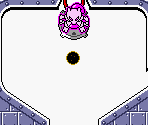
Light all three Poké Ball icons, one per catch or two per evolution, then shoot the ball into the centre hole to play a bonus stage. Clear the table’s first two bonus stages in turn and the third visit is Mewtwo. Each hit on Mewtwo scores 50,000,000 points, and 25 hits inside two minutes clears the stage. More →
Does Pokémon Pinball need a Rumble Pak?
No. The rumble motor is built into the game’s oversized cartridge and runs on a single AAA battery, which was included in the box and fits into a compartment in the cartridge. Rumble can be switched off in the options, and it does not work when the game is played through a Super Game Boy. More →
Pokémon
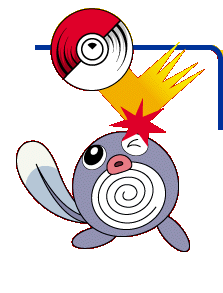
All the 151 Pokémon from the first generation appear in the game (150 of them can be caught in normal play, with Mew registered in the Pokédex just by meeting it), and many others are also featured, whether in the Bonus Stages or as pinball bumpers.
Bonus Stage Pokémon


Pokémon Bumpers
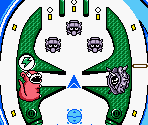
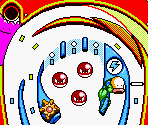
A few Pokémon are used as bumpers, replacing the classic pinball bumpers and objects. These Pokémon differ on each board and have various functions:
Blue Board Pokémon bumpers:
- Cloyster: Activates the catching mode.
- Poliwag: Triggers Map Move if its button is hit three times.
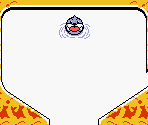
- Psyduck: Triggers Map Move if hit three times.
- Shellder: Used to flip the tiles from the shadowy Pokémon silhouette, in catching mode.
- Slowpoke: Starts Evolution Mode, if all its three lights are lit.
Red Board Pokémon bumpers:
- Voltorb: Used to flip the tiles from the shadowy Pokémon image while catching mode is active.
- Bellsprout: Once it swallows the ball, the catching mode gets activated.
- Ditto: It blocks the Evolution Cave until all three Evolution arrows are lit.
- Staryu: Toggles the Poké Ball upgrade lights.
- Diglett: Used to trigger the Map Move.
Pokémon bumpers present on both boards:
- Pikachu: Saves the ball from falling, rebounding it to the field (once its Thunder Meter is full).
Notable Pokémon
All 151 Kanto Pokémon have Pokédex entries. Each table has twelve locations with their own wild species, and roughly a third of the wild Pokémon appear on only one table, so both Red and Blue have to be played to fill the Pokédex. First-stage Pokémon are mostly caught directly, while nearly every evolved form, from Venusaur to Gengar, comes only from Evolution Mode. Pokémon also make up the tables themselves and star in the five bonus stages. Mew is the exception: it is registered on sight, as catching it is practically impossible.
 Mew#151
 Mewtwo#150
 Bulbasaur#001
 Charmander#004
 Squirtle#007
 Pikachu#025
 Articuno#144
 Zapdos#145
 Moltres#146
 Eevee#133
- Mew – Can appear at Indigo Plateau (1-in-16) after two Mewtwo stage clears; needs 1,024 hits, so only its Pokédex entry is realistic.
- Mewtwo – Rare three-arrow catch at Indigo Plateau on both tables, and the boss of the final bonus stage.
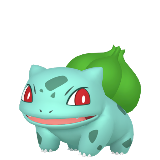
- Bulbasaur – Found on both tables: Pallet Town on Red, Viridian City on Blue.
- Charmander – Red Field only, caught in Pallet Town.
- Squirtle – Blue Field only, caught in Viridian City.
- Pikachu – Wild in Viridian Forest on both tables, and the Kickback that saves draining balls.
- Articuno – Red Field only, a three-arrow catch at the Seafoam Islands.
- Zapdos – Red Field only, a three-arrow catch in Lavender Town.
- Moltres – Three-arrow catch at Indigo Plateau on both tables.
- Eevee – Blue Field only, a three-arrow catch in Celadon City alongside Porygon.
Game Features
Catching Pokémon: A single Pokémon can be caught at a time. To activate the Catching Mode, the player lights at least two of the Catch ‘Em arrows and then shoots the ball into Cloyster on the Blue Board or Bellsprout’s mouth on the Red Board. With that done, a shadowed picture of a Pokémon will appear instead of the area picture. Parts of the Pokémon picture will get more and more visible as the player hits the Voltorb on the Red Board and the Shellder on the Blue Board. The fully visible picture will turn into an actual Pokémon, which the player has to hit four times with the ball to catch it.
Evolving Pokémon: As with the catching process, only one Pokémon can be evolved at a time. Evolution Mode only becomes available once at least one Pokémon has been caught. To activate Evolution Mode, the player has to pass the ball through the part of the board where three arrows are pointing. Passing the ball through there once will light one of the arrows. All three arrows have to be lit, which means the ball has to go through there three times. Once Evolution Mode is activated, the player selects which Pokémon to evolve and, according to its evolution method, has to hit certain objects on the board a number of times. If the Pokémon evolves with experience, the player has to hit the ‘EXP’ tokens. If it evolves with a stone, they have to hit the respective stone. If it evolves through trade, they have to hit the Link Cable. After the needed object is hit enough times, a hole will appear in the middle of the lower part of the board, and the ball has to be shot in there, finalising the evolution process.
Bonus Stages: There are three Poké Balls displayed on the screen. Catching a Pokémon will light one each time, while evolving a Pokémon will light up two of them. If the player manages to light up all three, a hole in the middle will appear, taking the player to a Bonus Stage if they shoot the ball through it. Completing a Bonus Stage will allow the player to unlock the next one if they light the Poké Balls again. There are three stages in total on each board, with the final stage on both boards being the Mewtwo Stage. The Diglett and Gengar Bonus Stages are exclusive to the Red Board, while the Meowth and Seel Bonus Stages are exclusive to the Blue Board.
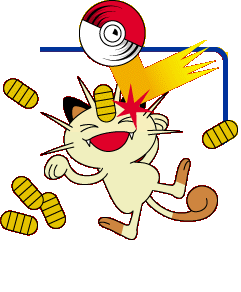
The Meowth Bonus Stage: It’s the first bonus stage on the Blue Board, with a time limit of one minute. The player here has to hit the moving Meowth with the ball. If hit, Meowth will drop coins the player can collect. When coins are collected, they’ll appear at the top of the screen. Once 20 piles of coins are collected, the stage is completed. If the player loses the ball, four piles of coins will be removed from the coins collected as a penalty, and they’ll get a new ball. Failing to complete the stage will just result in earning extra points.
The Seel Bonus Stage: It’s unlocked on the Blue Board after the Meowth one is completed, and has a time limit of a minute and a half. The player has to hit the three swimming Seel as they surface and show their heads. Each time a Seel is hit, a circle will appear at the top of the screen. Once 20 circles are collected, the stage will be completed. If the player loses the ball, they’ll get a penalty of four circles and then get a new ball.
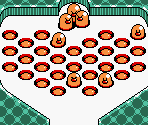
The Diglett Bonus Stage: It is the first bonus stage of the Red Board, and has no time limit. The player has to hit all the Diglett on the screen, which will force a Dugtrio to appear. Hitting the Dugtrio three times will complete the stage. If the ball is lost, the stage ends as a failure.
The Gengar Bonus Stage: It’s the second bonus stage for the Red Board, unlocked after completing the Diglett one, and has a time limit of a minute and a half. In order to complete the stage, the player first has to hit 10 Gastly, then 10 Haunter, and finally hit the Gengar that will appear five times. Losing the ball incurs no penalty in this stage.
The Mewtwo Bonus Stage: It’s the final bonus stage on both boards and has a time limit of two minutes. To complete the stage, the player has to hit the shadow orbs rotating near Mewtwo, causing them to disappear, and hit Mewtwo himself 25 times. The stage awards an insane amount of points, as hitting the orbs will earn the player 1,000,000 points and hitting Mewtwo will get them 50,000,000 points every time. A trick to stack up a maximum amount of points is to hit Mewtwo up to 24 times, then wait for the time limit and fail the stage. If the stage is failed, the player can re-access it once they light the three Poké Balls again. Completing the stage, on the other hand, will reset the stage cycle back to the first stage.
Poké Ball Upgrade: Lighting up the three lights at the top of the board will upgrade the Poké Ball, first into a Great Ball, then an Ultra Ball and finally a Master Ball. If the ball is used to catch a Pokémon, the points earned will be multiplied depending on the upgrade: x2, x3 and finally x5 respectively. If the player tries to upgrade the ball further when it is at the Master Ball level, they’ll earn 10,000,000 points.
The Pokédex: The game features a Pokédex the player can access to see which Pokémon they have caught so far, and which ones are still missing. It is very similar to the Pokédex in the first-generation Pokémon Game Boy games.
The Slot Machine: Hitting certain areas on the board will light up letters that spell out ‘CAVE’, activating the Slot Machine, which provides a variety of bonuses.
Map Move: To capture all the Pokémon, the player has to move through different areas, as each one offers different Pokémon to catch. Each board has a different set of areas, with various sub-locations. Hitting certain bumpers on the board will trigger the Map Move, changing the location to a random one from a different area. These areas are mainly located within the Kanto region – see the full lists for each board below.
In depth: the fine print

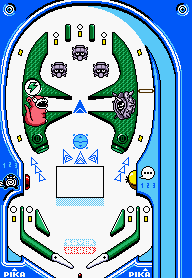
The Red & Blue Fields
Each of the two tables has its own layout, its own Pokémon bumpers and its own twelve locations, split into three areas – and roughly a third of the wild Pokémon only turn up on one of them. Charmander, for instance, can only be caught on the Red Field and Squirtle only on the Blue Field, so a complete Pokédex means playing both.

| Red Field | Blue Field | |
|---|---|---|
| Area One | Viridian Forest, Pewter City, Rock Mountain, Lavender Town, Vermilion City Seaside, Pallet Town, Cerulean City | Viridian City, Viridian Forest, Mt. Moon, Cerulean City, Vermilion City Streets, Rock Mountain, Celadon City |
| Area Two | Safari Zone, Seafoam Islands, Cinnabar Island, Cycling Road | Safari Zone, Saffron City, Cinnabar Island, Fuchsia City |
| Area Three | Indigo Plateau | Indigo Plateau |
| Bonus stages | Diglett, Gengar, Mewtwo | Meowth, Seel, Mewtwo |
Regional Variations
Pokémon Pinball was tweaked a little for each region, and the European version, which arrived over a year after the others, had the most changes:
- The Japanese release spells HOLE in the four lane lights and shows GET during a capture; the English versions use CAVE and CATCH! instead.
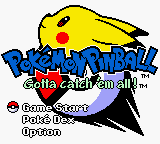
- Pikachu on the title screen was given a smile for the English releases, and the European version corrects the title screen’s ‘Poké Dex’ to ‘POKéDEX’.
- Jynx’s black skin was recoloured purple in the European release, on both its portrait and its catch sprite.
- European copies open with a language-select screen on first start-up and offer three preset control layouts, whereas the Japanese and American versions let every button be remapped.
- Rumble is simply on or off in Japan and North America; the European version adds Mild and Strong settings that can be changed while paused, and its RUMBLE logo has a slightly wider M.
- The Japanese version takes its Pokédex text from Pokémon Yellow, while the English versions use the Red and Blue entries; the Japanese game otherwise shows English text with romanised Pokémon names, keeping katakana for the Pokédex.
- The English copyright screen credits Creatures Inc. and HAL Laboratory, Inc. by their full company names and the European one was updated for its 2000 release; the Japanese Super Game Boy border lacks a trademark symbol, while the European border uses a brighter blue logo.
- The English versions add one extra sound effect, taking the total from 77 to 78.

Glitches, exploits and oddities
A near-impossible Mew, a counter that pays out a billion points and a few other quirks:
Mew’s 1,024-hit capture
Mew is coded so that it cannot be caught with the usual four hits. A special routine counts every hit on it, and each of the four steps of the CATCH! sequence only advances after 256 hits, making 1,024 in all. Those hits must land inside Catch ‘Em Mode’s two-minute limit, which works out at eight or nine hits a second, far beyond normal play. Fans who studied the code confirmed the routine, and the game makes up for it by unlocking Mew’s Pokédex entry as soon as it appears.
The billion-point catch counter
The tally of Pokémon caught that the game keeps for scoring can only hold 255. Catching one more does not crash anything: the counter wraps round to zero and the game pays out 1,000,000,000 points, the biggest single award on either table. Reaching it needs an enormously long session, because every catch means a fresh two-minute Catch ‘Em Mode with six bumper hits and four hits on the target.
Evolving the unevolvable
Evolution Mode lets players choose any Pokémon they have caught, including ones with no further evolution, such as Tauros, Lapras or Mewtwo. The mode plays out exactly as normal: three items are collected, the ball is sunk in the hole, and the Pokémon goes through the evolution animation only to come out unchanged. Instead of a new Pokédex entry the game awards a flat 10,000,000 points, which turns this quirk into a useful score boost once a player’s evolution lines are complete.
Super Game Boy and original Game Boy quirks
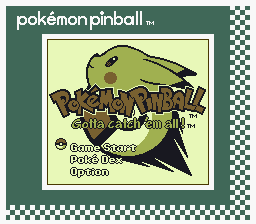
Although the cartridge carries its own rumble motor and battery, the rumble is disabled when the game runs on a Super Game Boy, even though the adaptor gives the game its own decorative border. On original monochrome Game Boy hardware the game adjusts its presentation instead: the table borders use a different texture and the lettering on the lights is removed, keeping the playfields readable without colour.
Videos & media
Check out these Pokémon Pinball videos, including TV commercials from Japan and the US plus the intro.
A Japanese TV commercial.
A US TV commercial.
The intro theme.
Trivia & facts
- The stamped letters on the Poké Balls do not match their English names. An ‘S’, which stands for ‘Super’, is stamped on the Great Ball, while an ‘H’, which stands for ‘Hyper’, is stamped on the Ultra Ball – their Japanese names.
- Mew is the rarest Pokémon in the game, as encountering it requires a tremendous amount of effort. After completing the Mewtwo stage twice, there’s a 1/16 chance to encounter Mew in the Indigo Plateau location. Once encountered, Mew will automatically be added to the Pokédex as if it had been captured, since actually capturing it requires hitting it 1,024 times with the Poké Ball, which is nearly impossible.
- The Pokédex in Pokémon Pinball is very similar to the one in Pokémon Red and Pokémon Blue – the English versions even reuse their Pokédex entries, while the Japanese version borrows Pokémon Yellow’s.
-

The Pokémon Pinball logo. There may once have been a third board: a fragment of unused graphics survives in the game’s data, along with two unused logos and two unused fonts.
- There are two locations in the game that are actually misspelt. One is Rock Mountain, which is properly Rock Tunnel, and the other is Fuchia City, which is normally Fuchsia City.
Further trivia
- Satoru Iwata, then president of HAL Laboratory and later of Nintendo, is credited with the game’s kernel program.
- The Japanese version shows most of its text in English with romanised Pokémon names; katakana appears only in the Pokédex.
- Charmander can only be caught on the Red Field and Squirtle only on the Blue Field, while Bulbasaur turns up on both.
- The Japanese manual calls the tables 赤台 and 青台, ‘Red Table’ and ‘Blue Table’, and Nintendo Power’s 1999 coverage also used ‘Red Table’.
- Catching a 256th Pokémon in one game rolls the catch counter back to zero and awards 1,000,000,000 points, the largest single payout in the game.
- Developer Jupiter also made the Game Boy Advance sequel and later created Pokémon Picross for the Nintendo 3DS.
Legacy
What came after
- Japanese release – 14 April 1999. Launched as ポケモンピンボール on a dual-mode cartridge with built-in rumble.
- North American release – 28 June 1999. Sold 262,000 copies in its first 20 days, then the fastest start for a Game Boy game, and finished 1999 as the fourth best-selling video game in the US.
- Australian release – 13 July 1999. Sold on the same cartridge as the North American version.
- European release – 6 October 2000. Revised version with a language menu, adjustable rumble strength, preset controls and a recoloured Jynx; it went on to earn an ELSPA Gold award for UK sales.
- Pokémon Pinball: Ruby & Sapphire – 1 August 2003. Jupiter’s Game Boy Advance sequel with Hoenn Pokémon; it followed in North America on 2003-08-25 and Europe on 2003-11-14.
- Ruby & Sapphire on Wii U Virtual Console – 10 December 2014. The sequel reached the Wii U eShop in Japan first, with Europe and Australia following that week; the Game Boy Color original never got a Virtual Console release.
- Nintendo 3DS and Wii U eShops close – 27 March 2023. Purchases ended, taking the series’ only digital release (Ruby & Sapphire on Wii U) off sale.
- Nintendo Switch Online – Not available as of October 2026. Neither Pokémon Pinball game is in the Game Boy or Game Boy Advance libraries, despite regular requests from fans.
Where to play it today
As of October 2026 the only official way to play is on an original cartridge, which works on the Game Boy family through to the Game Boy Advance and the GameCube’s Game Boy Player. The rumble needs the cartridge’s own AAA battery and is disabled on a Super Game Boy, and infrared high-score swaps need two Game Boy Colors. There is no Virtual Console, Nintendo Switch Online or other modern release.
How it was made
Pokémon Pinball was developed by Jupiter, a Kyoto studio that had already worked with Nintendo on Mario’s Picross, with HAL Laboratory contributing; HAL’s then-president Satoru Iwata is credited with the game’s kernel program. Tsunekazu Ishihara headed a team of four producers with Takehiro Izushi, Hiroyuki Jinnai and Kunimi Kawamura, while Hiroshi Yamauchi served as executive producer. Masaru Kuribayashi, Hiroyuki Goto and Norichika Meguro handled design, Noriaki Teramoto and Daisuke Miyao programmed the game, Ken Sugimori supervised the graphics and Gō Ichinose composed the music under sound director Junichi Masuda. The game was first revealed in the March 1999 issue of the Japanese magazine The 64Dream, shortly before its April launch. Its big selling point was a rumble motor built into an enlarged cartridge with its own AAA battery, making it the first Game Boy game that could vibrate in the player’s hands.
Sales & reviews
Sales figures
As with the classic Pokémon games, Pokémon Pinball achieved some great sales, earning the title of one of the best-selling games in its genre. The game sold around 1.01 million copies in Japan, 1.12 million in Europe and 3.02 million in North America, hitting an astonishing total of around 5.31 million copies sold globally (once around 0.16 million from the rest of the world is added).
Those figures are estimates from VGChartz. Firmer milestones: it sold 262,000 copies in North America in its first 20 days, at the time the fastest start for any Game Boy game; the NPD Group ranked it the fourth best-selling video game of 1999 in the US, behind only Pokémon Blue, Red and Yellow; and it earned an ELSPA Gold award for at least 200,000 sales in the UK.
- 5.31mworldwide (estimate)
- 3.02mNorth America
- 262kUS, first 20 days
- No. 4US best-sellers, 1999
Review scores
As the sales show, the game was very well received and earned high scores on major review websites. Let’s take a look at these reviews:
- Craig Harris from IGN really liked the game, stating “It’s a great title to just kick back and play for a few sessions, and makes for one of those ‘Just one more time’ Game Boy titles”, and rating it 8/10, the equivalent of ‘Great’ on their scale.
- Cameron Davis from GameSpot also liked the simple style of the game, which featured the genre perfectly in a fun and unique way, calling it “one of the best pinball games on the machine” and rating the game 8.7/10, which equates to ‘Great’ on the GameSpot scale.
- On GameRankings (which closed in 2019), Pokémon Pinball earned a very high score of 81.73% from 11 reviews, a strong result for a Pokémon spin-off.
- Overall, the game successfully portrays the pinball genre while smoothly combining it with the Pokémon world, making Pokémon Pinball the perfect game for any Pokémon fan who also enjoys pinball.
Most critics felt Pokémon Pinball was much more than a quick cash-in on the Pokémon craze. Reviewers liked the bright, lively tables, the clever way catching and evolving were folded into pinball rules, and the collecting hook, which kept players coming back long after an ordinary pinball game would have worn thin. The built-in rumble was widely noticed: The New York Times expected other developers to copy it, while GameSpot enjoyed the novelty but disliked how fast it ate batteries. The usual complaints were unconvincing ball physics, the lack of multiball and having only two tables, and CNET found Pikachu turned up a little too often. French site Gamekult was a notable dissenter, but most outlets scored it around eight out of ten, and it averaged 81.73% on GameRankings.
Awards and honours:
Media & artwork
- Official artwork gallery from Pokémon Pinball – including Pokémon, logos and supporting art
- Box art from Pokémon Pinball, including several different regional variations
- Screenshots from Pokémon Pinball
Further reading
More pinball and Game Boy Color links on the site: