  |
|
| Titles | Pokémon Quest ポケモンクエスト (Pokémon Kuesuto) 寶可夢探險尋寶 (Taiwan, Hong Kong) · 宝可梦大探险 (mainland China edition) |
| Platforms | Nintendo Switch (Nintendo eShop download only) · iOS and iPadOS (App Store) · Android (Google Play) |
| Developer | Game Freak, with programming and planning support from Rebuild Games · China edition: NetEase |
| Publisher | Nintendo (Nintendo Switch, outside Japan) · The Pokémon Company (Switch in Japan; iOS and Android) · NetEase (mainland China edition) |
| Director / Producer | Tetsuya Watanabe (director and producer) · producers Hitoshi Yamagami, Kazunori Sugiura and Takanori Sowa |
| Music | SuperSweep: Teruo Taniguchi, Takahiro Eguchi, Fumihisa Tanaka and Shinji Hosoe |
| Players | 1 |
| Genre | Action RPG |
| Business model | Free-to-start: optional one-off Expedition Packs and Power Stone packs; PM Tickets earned through play |
| Pokémon | 151 (Bulbasaur to Mew), all as cube-shaped Pokéxels |
| Areas | 12 on Tumblecube Island, including the Chamber of Legends and the post-game Happenstance Island · 10 statues · 18 recipes |
| Released | Nintendo Switch: 29 May 2018 (North America) · 30 May 2018 (Japan, Europe, Australia) · 18 June 2018 (South Korea) · 9 September 2025 (Taiwan) · 18 November 2025 (Malaysia, Singapore, Thailand) iOS and Android: 27 June 2018 (worldwide) |
| Service ended | Mainland China edition only (NetEase, 13 May 2021 – 10 February 2025); the global game is still live |
| Rating | ESRB E · PEGI 3 · CERO A · ACB G · GRB ALL · App Store 4+ |
| Predecessor | None |
| Successor | None (no sequel announced) |
| Downloads | More than 7.5 million across Switch and mobile by 6 July 2018 (The Pokémon Company) |
Overview
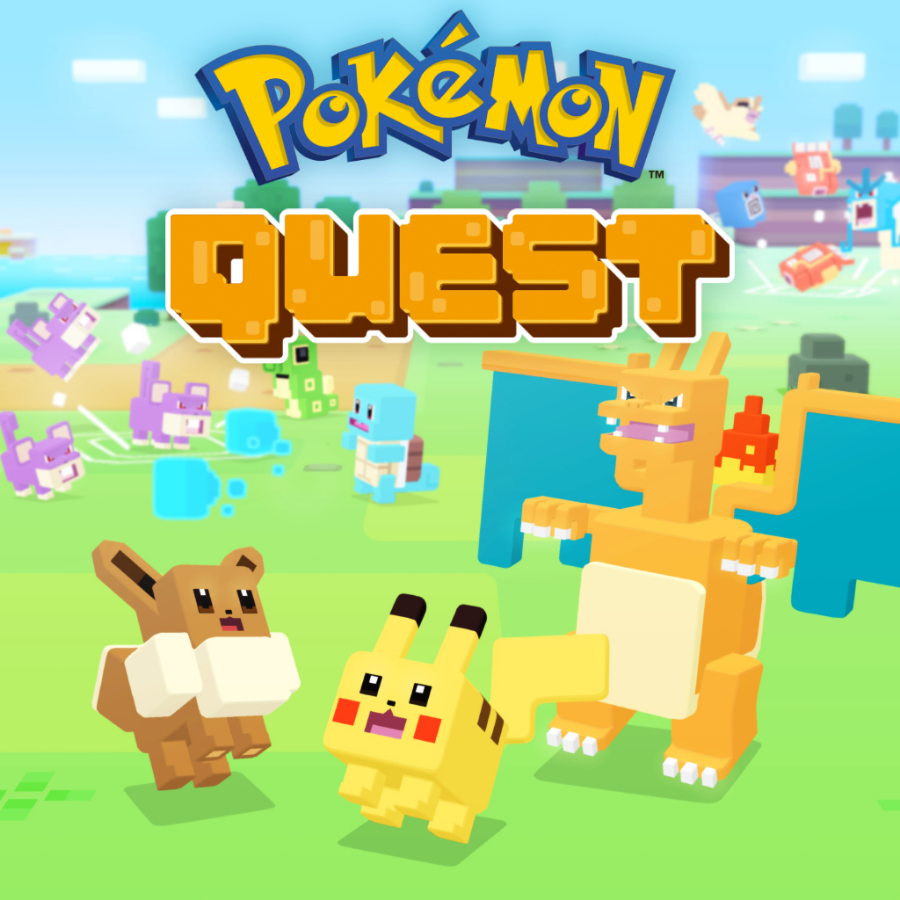
 Pokémon Quest is a free-to-start action RPG from Game Freak, set on Tumblecube Island, a remote landmass where the scenery, the ancient ruins and every last Pokémon are built out of cubes. The Pokémon have become Pokéxels, chunky toy-like versions of all 151 original Kanto species from Bulbasaur to Mew. Directed by Tetsuya Watanabe, the game was revealed and released on the same day: it appeared on the Nintendo eShop for Nintendo Switch on 30 May 2018 in Japan and Europe (29 May in North America), straight after The Pokémon Company’s press conference in Tokyo, and the iOS and Android versions followed on 27 June 2018.
Instead of wandering a region, you lead a team of three Pokémon on expeditions into the island’s stages, where they take on waves of wild Pokémon largely by themselves. Your job is to tap each Pokémon’s moves as they recharge, or to scatter the team out of the way of a big attack. Victories bring home ingredients and Power Stones. Back at base camp, ingredients go into a cooking pot to make one of 18 dishes that lure new Pokémon, stones slot into each Pokémon’s Power Charm to raise its stats, and decorations bought with PM Tickets add handy bonuses. A battery keeps sessions short: it holds five expeditions and recovers one charge every 30 minutes.
Quest was a low-key curtain-raiser for the core series, arriving six months ahead of Pokémon: Let’s Go, Pikachu! and Let’s Go, Eevee!, which were announced at the same conference. Critics found it charming but thin, and it sits at 64 on Metacritic for Switch and 62 for iOS, yet players flocked to it: by early July 2018 The Pokémon Company had counted more than 7.5 million downloads across Switch and mobile.
In 2021 NetEase opened an expanded edition in mainland China, a rare official Pokémon release there, which added Pokémon from later generations before closing in February 2025. Everywhere else the original is still on sale, and the mobile version picked up another bug-fix update as recently as October 2026.
Welcome to Tumblecube Island, where Pokémon™ have turned into cubes?
Set off for adventure in the Pokémon™ Quest game. Venture out with your Pokémon buddies on expeditions across Tumblecube Island in search of loot in this free-to-start action-adventure for the Nintendo Switch™ system. Modify your Pokémon buddies with discovered Power Stones to make your ultimate expedition team.
With a cube-shaped art style, Pokémon™ Quest is unlike any Pokémon game you’ve seen before. The simple gameplay makes it easy to hop into expeditions and start exploring Tumblecube Island with the help of your Pokémon buddies. Afterwards, head back to your base camp where you can use the loot you found during your adventure to befriend more Pokémon. Attract various Kanto Region Pokémon to your base camp by cooking up dishes made with collected ingredients! You can even decorate your base camp with fun items that provide helpful bonuses that make your expeditions more beneficial.
— Official description
Quick Answers
The questions people most often ask about Pokémon Quest, answered up front and covered in more depth further down the page.
Is Pokémon Quest free, and is it pay-to-win?
It is free to download on Switch, iOS and Android. The optional Expedition Packs (US$4.99 to US$17.99, or US$29.99 for all three) each add an extra cooking pot, an extra battery charge, bonus decorations and Pokémon that know special moves. They speed things up considerably, but all 151 Pokémon can be befriended without paying a penny, and free PM Tickets arrive every 22 hours. More →
Can you still play Pokémon Quest in 2026?
Yes. In October 2026 the Switch version is still on the Nintendo eShop, and the mobile version is still on the App Store and Google Play, where it received version 1.0.10, a bug-fix update, in mid-October. Only the separate NetEase-run edition for mainland China has gone, having shut down on 10 February 2025. More →
Is Pokémon Quest on Switch or on phones?
Both. It arrived on the Nintendo eShop for Switch on 29 May 2018 in North America and on 30 May in Japan and Europe, then on iOS and Android on 27 June 2018. The two versions are essentially the same game, and the Switch edition is download-only, with no physical release. More →

How many Pokémon are in Pokémon Quest?
The global version has the original 151 Kanto Pokémon, from Bulbasaur to Mew, all rebuilt as cube-shaped Pokéxels. There are no Dark-type Pokémon, because none of the original 151 has that type in its Kanto form. NetEase’s mainland China edition added Pokémon from later generations through events, but the global roster has never grown. More →
How do you get Mewtwo, Mew and the Legendary birds?
Finish the story by clearing the Chamber of Legends, then explore Happenstance Island, the only place where Mystical Shells drop. Cooking Ambrosia of Legends à la Cube with them attracts Articuno, Zapdos and Moltres, and a top-quality Special dish can also bring Mewtwo or, far more rarely, Mew to base camp. More →
Which starter Pokémon can you choose?
You pick one of five partners at the start: Pikachu, Eevee, Bulbasaur, Charmander or Squirtle. The choice only decides your first team member. The other four can be attracted later by cooking, as colour-based dishes such as Red Stew, Blue Soda and Yellow Curry can draw them at higher qualities. More →
Does Pokémon Quest connect to Pokémon HOME or other games?
No. Pokémon Quest has no links with Pokémon HOME, the core series or any other Pokémon game, so its Pokémon stay on Tumblecube Island. The game does get a cameo in Pokémon Sword and Shield’s The Isle of Armor, where Mustard can sometimes be seen playing it at the Master Dojo. More →
Is there a Pokémon Quest sequel?
No sequel has been released or announced. The nearest thing to a follow-up was the mainland China edition, published by NetEase in May 2021, which added Pokémon from later generations, seasonal events and a new island before closing in February 2025. The original game still gets the occasional bug-fix update. More →
Story
The player arrives on Tumblecube Island, a recently discovered island scattered with the ruins of a vanished civilisation, hoping to find treasure. Along for the trip is MoBee IV, a drone built by Silph Co., which behaves strangely from the outset and, after a reboot, admits that it has no information about the island at all. Its advice is to team up with a Pokémon who knows the land, and so the player befriends one of five partners: Pikachu, Eevee, Bulbasaur, Charmander or Squirtle.
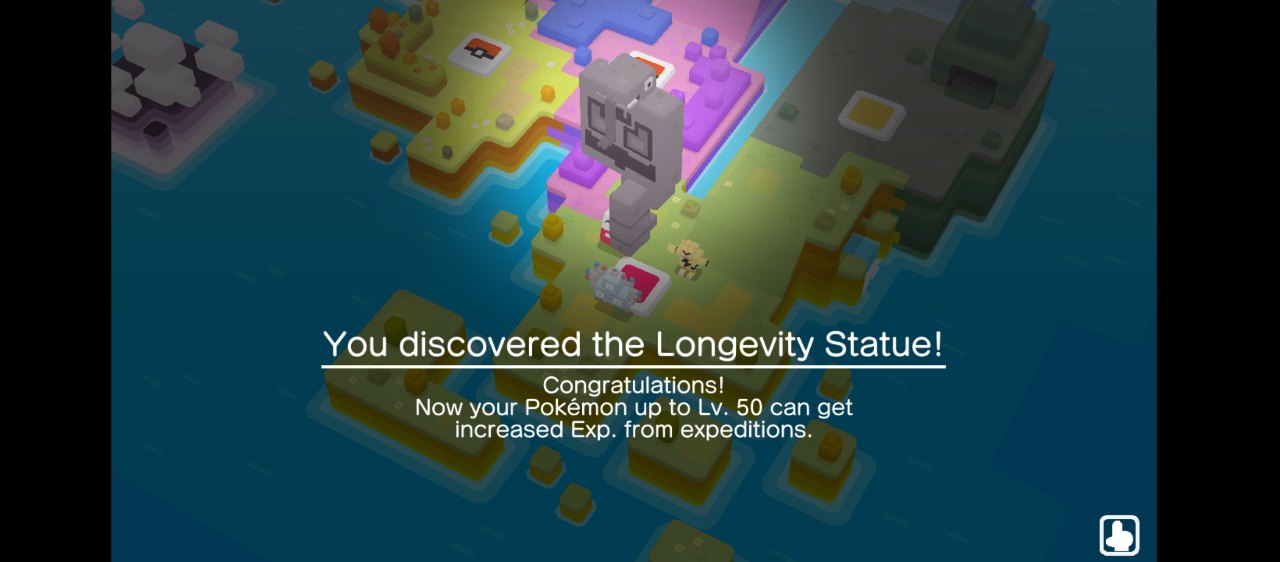
From a base camp in First Steppe, the player cooks to attract more Pokémon, trains them up and leads expeditions into one area after another, each guarded by powerful wild Pokémon. Clearing an area uncovers a cube-shaped Pokéxel statue. Nobody explains what the statues are for, but they plainly matter, and when the tenth and last, the Reverent Statue, is found, MoBee IV malfunctions and a bridge rises out of the sea to the Chamber of Legends.
Inside waits Mewtwo. The statues had kept it sealed away, and it had been quietly steering the drone all along so that the player would gather them and set it free. Mewtwo battles the player and, once beaten, leaves, conceding that it owes them. After the credits, MoBee IV detects a surge of energy and a second landmass, Happenstance Island, rises from the ocean. Its terrain and inhabitants change on every visit, which gives the game an endless post-game challenge.
Who’s who
- The player: An explorer who comes to Tumblecube Island in search of treasure. With MoBee IV, the player sets up camp in First Steppe, befriends a first partner and builds a team strong enough to clear every area, collecting the statues that unwittingly lead to Mewtwo’s release.
- MoBee IV: The player’s flying robot companion, made by Silph Co. It behaves oddly on arrival and, after a reboot, admits it has no data on the island. Mewtwo has been manipulating it all along; it malfunctions after the final statue and later detects the energy that raises Happenstance Island.
- Mewtwo: The final boss, imprisoned in the Chamber of Legends by the island’s ten statues. It steers MoBee IV so that the player will collect them and break the seal, fights the player once it is free and departs after losing, admitting it owes them. It can later be attracted with Ambrosia of Legends.
Cooking and expeditions on Tumblecube Island

There are no Poké Balls in Pokémon Quest: every new team member is tempted to base camp with food. Expeditions across Tumblecube Island’s 12 areas turn up ten kinds of ingredient, which fill the five slots of a cooking pot to make one of 18 dishes, each a favourite of Pokémon of a certain colour or type. Which Pokémon arrive, and how strong they are, depends on the pot, the quality of the dish and the expeditions run while it simmers, so exploring the island and cooking at camp form a single loop.
- 18recipes, every one ‘à la Cube’
- 10ingredients, from Tiny Mushrooms to Mystical Shells
- 4cooking pots: basic, Bronze, Silver and Gold
- 12areas to explore on Tumblecube Island
Ingredients, pots and dishes
 Rainbow Matter can stand in for any ingredient, and up to 999 of each can be stored.
 The basic Cooking Pot uses three of an ingredient per slot and draws Pokémon of roughly Levels 1 to 15. The Bronze (10 per slot), Silver (15) and
 Gold (20) pots, won by clearing Backforth Brook, Pincushion Plain and the Chamber of Legends, bring in progressively higher-level Pokémon with bigger stat bonuses. The Expedition Packs add up to three more pots, so four dishes can simmer at once.

The 18 recipes
The colour recipes (2 to 5) attract Pokémon of a matching colour, the next twelve each favour a single type, Ambrosia draws the Legendaries, and anything that fits nothing becomes Mulligan Stew:
| No. | Recipe | Ingredients | Pokémon it attracts |
|---|---|---|---|
| 1 | Mulligan Stew à la Cube | Any five ingredients that fit no other recipe | A broad mix of common basic-stage Pokémon; Very Good and Special dishes can also bring rarer ones such as Lapras, Snorlax, Dratini and Aerodactyl |
| 2 | Red Stew à la Cube | At least 4 red ingredients (Tiny Mushroom, Big Root) | Reddish Pokémon such as Spearow, Vulpix, Growlithe and Krabby; Special dishes favour Charmander, Farfetch’d, Eevee, Hitmonchan, Kabuto and Magmar |
| 3 | Blue Soda à la Cube | At least 4 blue ingredients (Bluk Berry, Icy Rock) | Bluish Pokémon such as Poliwag, Tentacool, Machop and Horsea; Special dishes favour Squirtle, Magikarp, Omanyte, Lapras, Ditto and Dratini |
| 4 | Yellow Curry à la Cube | At least 4 yellow ingredients (Apricorn, Honey) | Yellowish Pokémon such as Pidgey, Meowth, Psyduck and Ponyta; Special dishes favour Bulbasaur, Pikachu, Drowzee, Kangaskhan, Scyther, Electabuzz and Snorlax |
| 5 | Gray Porridge à la Cube | At least 4 grey ingredients (Fossil, Balm Mushroom) | Greyish Pokémon such as Geodude, Rhyhorn, Onix and Magnemite; Special dishes favour Cubone, Venonat, Gastly, Chansey, Mr. Mime, Tauros and Aerodactyl |
| 6 | Mouth-Watering Dip à la Cube | At least 4 soft and 3 blue ingredients | Water-type Pokémon |
| 7 | Plain Crepe à la Cube | At least 3 sweet and 2 grey ingredients | Normal-type Pokémon |
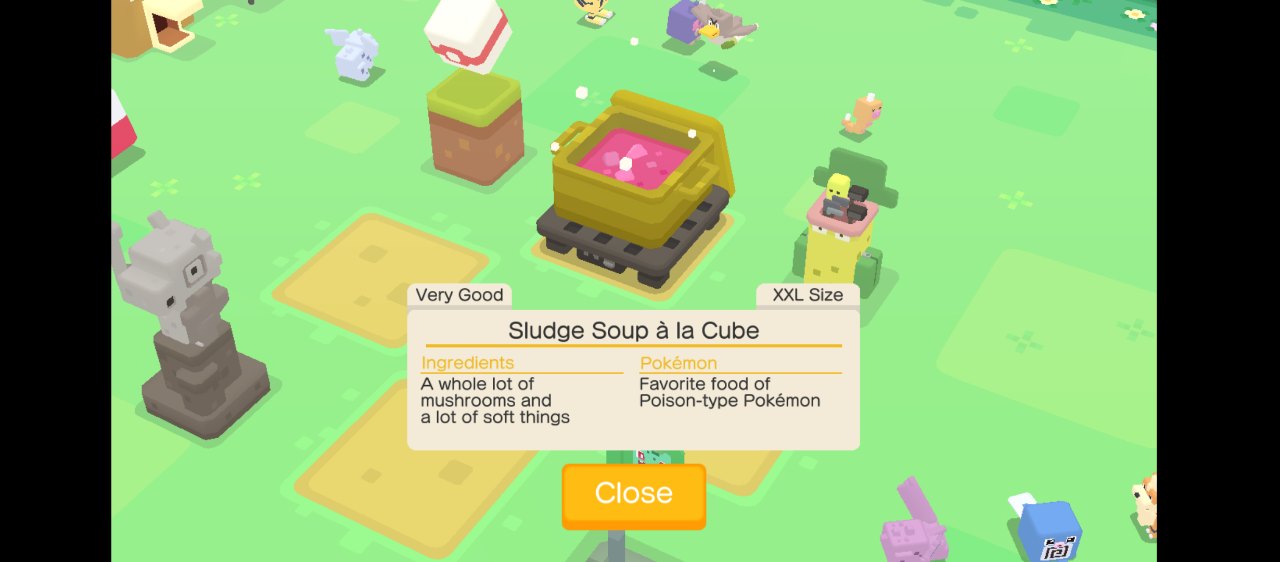
| 8 | Sludge Soup à la Cube | At least 4 mushrooms and 3 soft ingredients | Poison-type Pokémon |
| 9 | Mud Pie à la Cube | At least 2 minerals and 3 soft ingredients | Ground-type Pokémon |
| 10 | Veggie Smoothie à la Cube | At least 4 plants and 2 soft ingredients | Grass-type Pokémon |
| 11 | Honey Nectar à la Cube | At least 4 sweet and 3 yellow ingredients | Bug-type Pokémon |
| 12 | Brain Food à la Cube | At least 3 sweet and 2 hard ingredients | Psychic-type Pokémon |
| 13 | Stone Soup à la Cube | At least 4 hard ingredients and 2 minerals | Rock-type Pokémon |
| 14 | Light-as-Air Casserole à la Cube | At least 3 minerals and 2 plants | Flying-type Pokémon |
| 15 | Hot Pot à la Cube | At least 3 mushrooms and 2 red ingredients | Fire-type Pokémon |
| 16 | Watt a Risotto à la Cube | At least 4 soft and 3 yellow ingredients | Electric-type Pokémon |
| 17 | Get Swole Syrup à la Cube | At least 3 sweet ingredients and 2 mushrooms | Fighting-type Pokémon |
| 18 | Ambrosia of Legends à la Cube | Mystical Shells, which drop only on Happenstance Island | Articuno, Zapdos and Moltres; a Special-quality dish can also attract Mewtwo and, very rarely, Mew |
Expeditions, statues and the post-game

 Mystical Shells are found only on Happenstance Island, where the harder levels yield more ingredients, and each shell in a pot adds one expedition to the cooking time. They are the key to
 Ambrosia of Legends à la Cube, the only dish that attracts Articuno, Zapdos and Moltres. Made at Special quality it can also bring Mewtwo, nearly half the time, and Mew, less than one time in 20.
Gameplay
On an expedition
 Mewtwo Arch (700 PM Tickets) adds a charge, and each paid Expedition Pack brings another battery decoration, the Perfect Pair Statue, the Eevee Arch or the Pikachu Arch. Several main and challenge quests hand out a five-charge refill, and PM Tickets can top the battery up instantly. The waits between sessions were among critics’ most common complaints, especially on Switch.
Building a stronger team
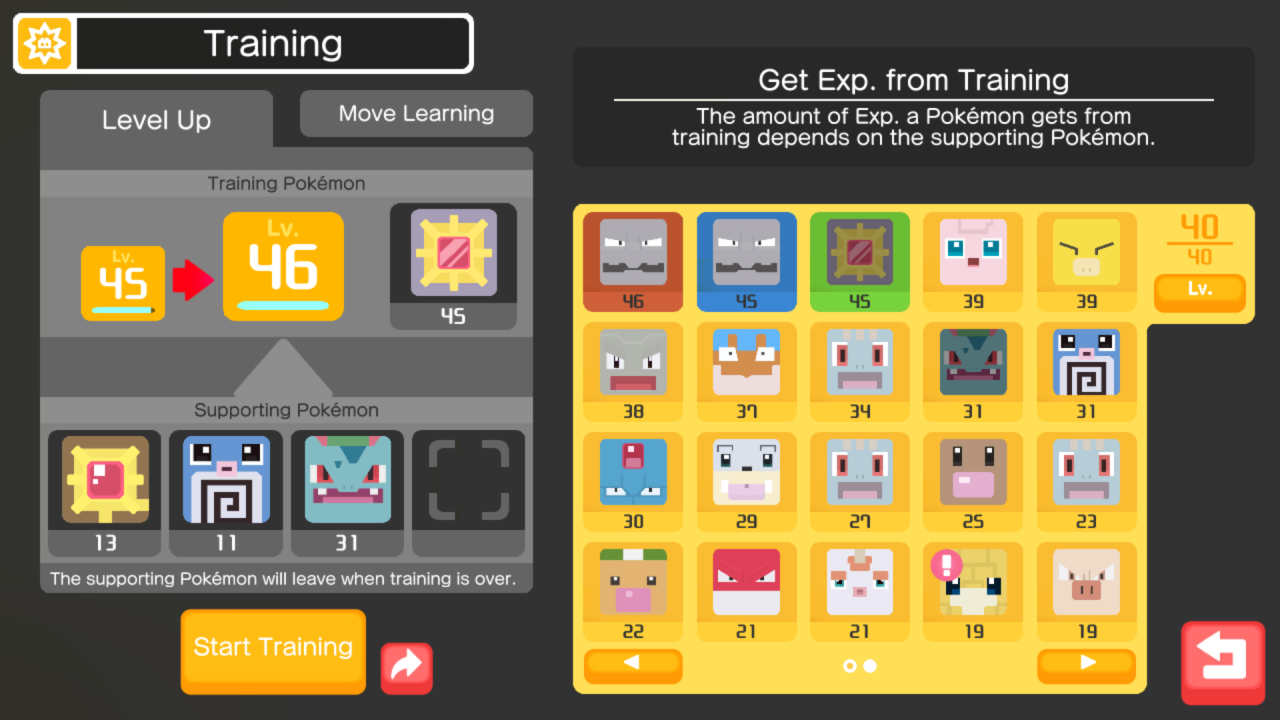
Base camp, the Poké Mart and Expedition Packs

 PM Tickets, the in-game currency, alongside the paid downloadable content. Prices run from 50 PM Tickets for a Cusheon to 800 for the Kangaskhan Swing Chair, and each Pokémon Box or Stone Box Expansion costs 50 and adds 20 spaces, up to 300. Tickets come in steadily: every player is automatically enrolled in a Member Service that pays 50 PM Tickets every 22 hours, quests hand out more, and every real-money purchase includes a one-off bonus of 100. Tickets can also finish a dish instantly.
 Snorlax Lounger.
Quests
Areas of Tumblecube Island

Tumblecube Island has 12 areas. The ten regular ones open in four groups, each holding part of the trail of statues that leads to the Chamber of Legends, and Happenstance Island rises from the sea once the story is over. Every area lists a bonus type, and its clear quest pays out a reward the first time it is beaten:
| Area | Group | Bonus type | Clear reward | Notes |
|---|---|---|---|---|
| First Steppe | 1 | Fighting | Wait Less Stone | The opening area and home of base camp; its last stage reveals the Prolific Statue, the first of ten |
| Gloomy Grove | 2 | Fire | Scattershot Stone | Opens with Backforth Brook once First Steppe is cleared; the pair share the Spring Showers and Flourishing Statues |
| Backforth Brook | 2 | Grass | Bronze Cooking Pot | Its reward is the first pot upgrade, which takes ten ingredients per slot |
| Parched Peak | 3 | Flying | Battery recharge (+5) | First of three areas that open together and share the Tranquility, Gentle Breeze and Abundance Statues |
| Belly Button Cave | 3 | Water | Broadburst Stone | A cave area in the third group, alongside Parched Peak and Pincushion Plain |
| Pincushion Plain | 3 | Bug | Silver Cooking Pot | The Silver pot uses 15 ingredients per slot and draws far stronger Pokémon than the Bronze |
| Miasma Moor | 4 | Rock | Battery recharge (+5) | Opens the final group, which shares the Purification, Burning Mane, Longevity and Reverent Statues |
| Hushed Highlands | 4 | Ground | Stay Strong Stone | One of the four areas in the last group |
| Nightlight Nook | 4 | Psychic | Sharing Stone | Shares its statues with Miasma Moor, Hushed Highlands and Farside Fjord |
| Farside Fjord | 4 | Electric | Whack-Whack Stone | The last of the ten regular areas; with every statue found, a bridge rises to the Chamber of Legends |
| Chamber of Legends | Finale | – | Gold Cooking Pot | Area 11, where Mewtwo waits as the final boss; beating it rolls the credits |
| Happenstance Island | Post-game | – | Mystical Shells | Area 12, reshuffled on every visit, with nine difficulty levels |
 First Steppe
 Chamber of Legends
Happenstance Island

Unlocked after the credits, Happenstance Island is the post-game area. Its layout and the Pokémon met there are reshuffled on every expedition, drawing on rosters themed on the ten main areas. There are nine difficulty levels, 12-1 to 12-8 plus a boss level, with recommended team strengths climbing from 18,000 to 36,500. Each stage has three regular waves, a boss wave and a final boss, a five-minute time limit and a record of the fastest clear. The harder the level, the better the chance of meeting Articuno, Zapdos, Moltres or Mewtwo, and the island is the only place to find Mystical Shells.
Pokémon
The global game has exactly 151 Pokémon: the complete Kanto Pokédex from Bulbasaur to Mew, each rebuilt as a blocky Pokéxel. New team members are drawn to base camp by cooking, which only ever attracts basic-stage Pokémon, so every evolved form has to be raised by levelling up. Five partners are offered at the start, four Pokémon with special moves come in the paid Expedition Packs, and the Legendary and Mythical Pokémon are held back for the post-game Ambrosia of Legends. Outside China the roster has never changed.
Starting partners
The partner chosen at the start is simply your first team member, and the other four can all be attracted later: each is a favourite of a Special-quality colour dish, shown under its name below.
 PikachuSpecial Yellow Curry
 EeveeSpecial Red Stew
 BulbasaurSpecial Yellow Curry
 CharmanderSpecial Red Stew
 SquirtleSpecial Blue Soda
Expedition Pack Pokémon
Each paid pack includes Pokémon at Level 1 that already know a move they would not normally have, and two of them come with their own decorations: the Lapras Pool and the Snorlax Lounger.
 Nidoran♀Expedition Pack · Sing
 Nidoran♂Expedition Pack · Work Up
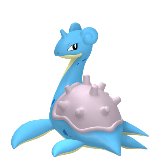 LaprasGreat Expedition Pack · Aqua Ring
 SnorlaxUltra Expedition Pack · Play Rough
Legendary and Mythical Pokémon
Articuno, Zapdos, Moltres, Mewtwo and Mew can only be befriended after the story. Mewtwo is fought as the final boss in the Chamber of Legends, and the Legendary birds and Mewtwo turn up as bosses on Happenstance Island, more often on its harder levels, but the only way to bring any of them home is a pot of Ambrosia of Legends à la Cube made with Mystical Shells. Mewtwo and Mew only come from a Special-quality dish, and even then Mew appears less than one time in 20.
 ArticunoAmbrosia of Legends
 ZapdosAmbrosia of Legends
 MoltresAmbrosia of Legends
 MewtwoAmbrosia of Legends
 MewAmbrosia of Legends
A few ordinary Pokémon are rare visitors that generally need a Very Good or Special dish to appear, Ditto among them:
 DittoBlue Soda, Mulligan Stew
 DratiniBlue Soda, Mulligan Stew
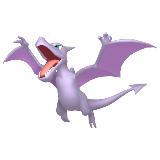 AerodactylGray Porridge, Mulligan Stew
Updates & the China edition
Quest has led a quiet life since launch: a burst of patches in its first summer, the odd bug-fix release since, and no new Pokémon outside China. The main versions:
| Date | Version | What changed |
|---|---|---|
| 30 May 2018 | Switch 1.0.0 | Launch on the Nintendo eShop (29 May in North America) |
| 27 June 2018 | Mobile 1.0.0 | Launch on iOS and Android |
| 10 July 2018 | Switch 1.1.0 | A gift of 500 PM Tickets and assorted fixes |
| 12 July 2018 | Mobile 1.0.2 | A new quest and improved functionality |
| 20 July 2018 | Mobile 1.0.3 | Bug fixes |
| 28 May 2024 | Android 1.0.9 | An option to delete a player account |
| 16 October 2026 | Mobile 1.0.10 | Bug fixes for iOS and Android |
The mainland China edition

On 13 May 2021 NetEase launched 宝可梦大探险 (Bǎokěmèng Dàtànxiǎn), an expanded edition of Quest for iOS and Android made with The Pokémon Company and Game Freak, giving mainland China a rare official Pokémon game of its own. Unlike the global version, it kept growing: seasonal events brought in Pokémon from later generations, from Heracross to Darkrai, Zacian and Zamazenta, and a third-anniversary update added a whole new island. The service closed on 10 February 2025, after almost four years.
Events announced in 2024, the edition’s last full year, included:
- January 2024: the Ice Festival, with Klink, Klang and Klinklang
- February 2024: a Lunar New Year event headlined by Ho-Oh, alongside Articuno, Zapdos and Moltres
- February 2024: Heracross’ Grand Debut
- March 2024: The Warm Spring, with Cacturne and Tangrowth
- April 2024: the 3rd Anniversary Eevee Festival, with Timburr, Gurdurr and Conkeldurr
- April 2024: the 3rd Anniversary New Island Celebration: a new island, plus Uxie, Mesprit, Azelf, Darkrai and Shining Mewtwo
Some of the later-generation Pokémon that joined the China edition:
 HeracrossChina edition
 Ho-OhChina edition
 CacturneChina edition
 TangrowthChina edition
 UxieChina edition
 DarkraiChina edition
 ConkeldurrChina edition
 KlinklangChina edition
 ZacianChina edition
 ZamazentaChina edition
Regional Variations
The Switch and mobile versions launched within a month of each other almost everywhere, but a few regions had a different story:
- Mainland China had its own expanded edition, 宝可梦大探险, run by NetEase from 13 May 2021 to 10 February 2025, with Pokémon from later generations, seasonal events and a new island.
- In Taiwan and Hong Kong the Chinese title is 寶可夢探險尋寶, meaning ‘Pokémon Treasure Quest’, rather than a direct translation of ‘Quest’. The Korean title is 포켓몬 퀘스트.
- South Korea received the Switch version on 18 June 2018, almost three weeks after Japan, Europe and North America.
- The Switch version reached the Nintendo eShop in Taiwan only on 9 September 2025, and in Malaysia, Singapore and Thailand on 18 November 2025, although the mobile version had been available there since 2018.
- Expedition Pack prices are set region by region: the 3-Pack Bundle costs US$29.99, €29.99, £26.99, A$45.00, ₩33,000 or ¥3,600.
Glitches, exploits and oddities
One early bug stood out on the mobile version:
Frozen team members
Shortly after the mobile launch, a bug could leave Pokémon in the player’s expedition team rooted to the spot after they used certain moves. Because team members normally walk into position and attack by themselves, a frozen Pokémon was a real handicap in the tougher stages. The Pokémon Company fixed the problem in a later bug-fix update for iOS and Android; the Switch version had already had its own round of fixes in version 1.1.0 on 10 July 2018.
Videos & media
Two official videos, one in English and one in Japanese:
The English-language trailer, from the official Pokémon YouTube channel.
The first footage shown in Japan, from The Pokémon Company’s Japanese channel.
Trivia & facts
- There are no Dark-type Pokémon on Tumblecube Island: the type arrived in Generation II, and none of the original 151 has it in its usual Kanto form.
- The cube-shaped Pokémon that live on the island are known as Pokéxels.
- In Japanese, Tumblecube Island is カクコロ島 (Kakukoro Island).
-

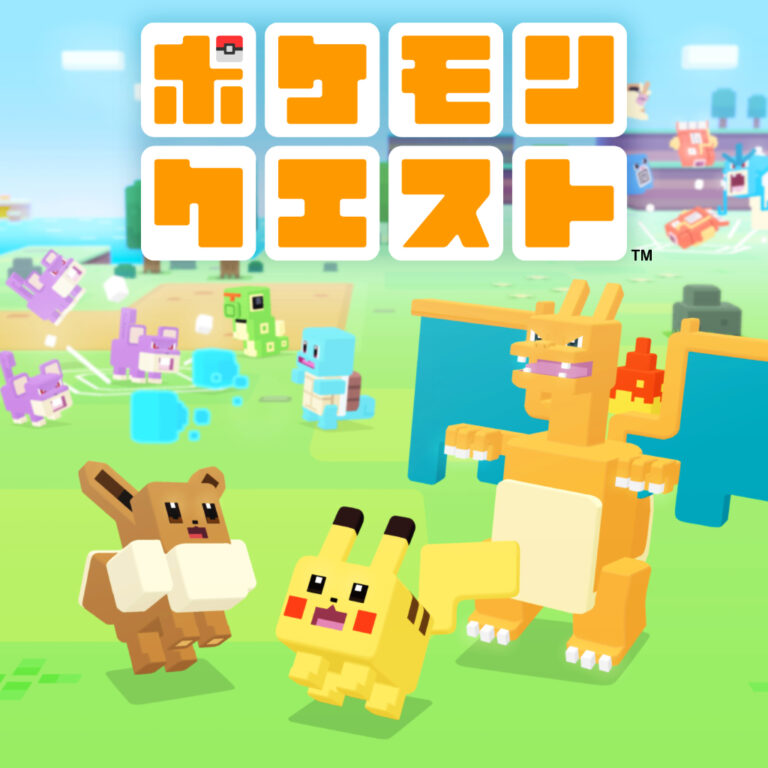
The Japanese logo. The Japanese official site sums the game up as ‘タップで手軽にわちゃわちゃ探検!’, roughly ‘Easy, rambunctious exploring with just a tap!’
- Buying ten decorations earns a free Premier Ball Model, a nod to the core-series tradition of a bonus Premier Ball when ten Poké Balls are bought at once.
-

Mulligan Stew à la Cube. Every recipe name ends in ‘à la Cube’, from the humble Mulligan Stew à la Cube to Ambrosia of Legends à la Cube.
- Cooking time is measured in expeditions rather than minutes, and even an expedition that ends in defeat brings a dish closer to being ready.
- The Pokémon cries are taken from the Generation V core-series games, such as Pokémon Black and White.
- Quest lets some Pokémon learn moves that they could not learn in any game before it.
- MoBee IV, the player’s guide drone, was built by Silph Co., the Kanto firm behind the Silph Scope and the Master Ball in the core series.
-

The China edition’s app icon. NetEase’s edition for mainland China, launched in May 2021, was a rare officially licensed Pokémon game there, and it came with its own app icon.

Legacy
What came after
- Reveal and Nintendo Switch launch – 30 May 2018. Announced and released on the same day in Japan and Europe; 29 May in North America
- One million Switch downloads – Early June 2018. Passed within two days of release, before the mobile version existed
- South Korean Switch release – 18 June 2018. Reached the Korean Nintendo eShop nearly three weeks after the first wave
- iOS and Android launch – 27 June 2018. Published by The Pokémon Company; players spent an estimated US$3 million in the first week
- 7.5 million downloads – 6 July 2018. The combined total across Switch, iOS and Android, announced by The Pokémon Company
- 10 million mobile installs – January 2019. An estimate by the analytics firm Sensor Tower, with about US$9.5 million spent by players
- Mainland China edition – 13 May 2021. NetEase’s expanded 宝可梦大探险, with Pokémon from later generations
- Mainland China edition closes – 10 February 2025. The service ended after almost four years
- Taiwan Switch release – 9 September 2025. Added to the Taiwanese Nintendo eShop more than seven years after launch
- South-east Asian Switch release – 18 November 2025. Added to the Nintendo eShop in Malaysia, Singapore and Thailand
- Version 1.0.10 – 16 October 2026. A bug-fix update for iOS and Android, a sign that the game is still looked after
Where to play it today
Pokémon Quest is still a free download in October 2026, on every platform it launched on. The Switch version is on the Nintendo eShop, which added Taiwan and then Malaysia, Singapore and Thailand in 2025, and the mobile version is on the App Store, where it now needs iOS or iPadOS 15.0 or later, and on Google Play; both mobile versions received version 1.0.10 in October 2026. The Expedition Packs can still be bought. Only NetEase’s edition for mainland China has gone, having closed on 10 February 2025.
How it was made
Pokémon Quest was made by Game Freak, with Tetsuya Watanabe credited as director and producer and Tsubasa Matsuzaki as art director. Ken Sugimori and Shigeru Ohmori acted as supervisors, and Junichi Masuda, Shinya Takahashi and Takato Utsunomiya as general producers. Kazuki Saita and Satoshi Muramatsu are credited for programming and Takeshi Kawachimaru and Kei Setoguchi for planning, with Rebuild Games contributing additional programming and planning. The sound and music came from SuperSweep’s Teruo Taniguchi, Takahiro Eguchi, Fumihisa Tanaka and Shinji Hosoe.
The game was unveiled on 30 May 2018 at The Pokémon Company’s press conference in Tokyo, the same presentation that revealed Pokémon: Let’s Go, Pikachu! and Let’s Go, Eevee!, and went live on the Nintendo eShop that day. Pre-registration for the mobile version opened in June, ahead of the 27 June launch on iOS and Android. In 2021 NetEase worked with The Pokémon Company and Game Freak on the expanded edition for mainland China.
Pokémon Quest elsewhere


Sales & reviews
Downloads and player spending
As a free-to-start game, Quest has download totals rather than sales. The Switch version passed one million downloads within two days of launch, before the mobile version even existed, and soon went beyond 2.5 million. On 6 July 2018, nine days after the iOS and Android launch, The Pokémon Company announced more than 7.5 million downloads across all three platforms. The analytics firm Sensor Tower estimated about 3.5 million mobile installs and US$3 million in player spending in the first week, about US$8 million in the first month, and roughly 10 million installs and US$9.5 million by January 2019. Japan was the biggest market for spending, with about a third of the first month’s revenue, ahead of the United States (24%) and South Korea (about 12%), and at launch the app went to No. 1 among free apps on Japan’s App Store and No. 2 in South Korea.
- 7.5m+downloads across Switch and mobile by 6 July 2018
- 1m+Switch downloads in its first two days
- ~US$9.5mestimated mobile player spending by January 2019
- 64on Metacritic, Switch (12 critics)
Review scores
Reviews were mixed. Nintendo Life called Quest “a fun little time waster that will satisfy your collect ’em all urges” and gave it 7/10. Game Informer, with 6/10, was far less taken: “With passive gameplay and constant random elements, Pokémon Quest is entirely forgettable”. IGN gave it the same score but was gentler in tone, finding that it “can be a cute little distraction when taken in bite-sized pieces”.
Most reviewers warmed to Pokémon Quest’s look and its generosity as a free game, but doubted it had much staying power. The cube-shaped Pokémon and Tumblecube Island were widely called charming, and the team-building side, picking three Pokémon, socketing Power Stones and chasing better moves, was singled out as the most rewarding part. The battles took the most criticism: with the Pokémon moving and attacking largely by themselves, several critics felt they were watching rather than playing, and noted that a strong enough team clears stages with no input at all. The long battery waits and the heavy randomness of cooking and training were frequent complaints, and many felt the game suited short sessions on a phone better than the Switch. Across the aggregators it settled in the low to mid 60s.
Media & artwork
Further reading
More Kanto, Switch and mobile links on the site: