  |
|
| Titles | Pokémon Play It! Pokémon Play It! Version 2 (revised edition, 2000) · Pokémon: Speel Het (Dutch edition, as named in its voice-overs) |
| Platform | Windows 95 & Windows 98 PCs (CD-ROM) |
| Developer | Fluid Entertainment |
| Publisher | Wizards of the Coast |
| Players | 1 (against the computer) |
| Genre | Digital card game · interactive tutorial |
| Distribution | Free inside Pokémon TCG products, never sold separately: the 2-Player CD-ROM Starter Set (Version 1) and the Thunderstorm / Tempest Gift Boxes (Version 2) |
| Decks | 4 Half Decks of 30 cards (Version 1) · 7 Theme Decks of 60 cards plus 3 Half Decks (Version 2) |
| Lessons & levels | 10 lessons (Version 1) · 15-level Play ladder (Version 2) |
| Card sets | Base Set and Jungle (Version 1) · adds Fossil and Team Rocket (Version 2) |
| Released | 1999 (Europe) · February 2000 (North America) · Version 2: 2000 (North America and Europe) · not released in Japan |
| Requirements | Windows 95/98, Pentium 133, 16 MB RAM, 4x CD-ROM drive, 16-bit colour at 800×600 |
| Successor | Pokémon Play It! Version 2 (2000); the next official computer version of the card game wasPokémon Trading Card Game Online (2011) |
| Sales | No figures: both discs were bundled, never sold on their own |
Overview
 Pokémon Play It! is a Windows CD-ROM that puts the Pokémon Trading Card Game on screen and teaches it from scratch. It was made by the Californian studio Fluid Entertainment and published by Wizards of the Coast, which ran the card game outside Asia at the time, and it was never sold as a game in its own right: the disc was a free extra in the 2-Player CD-ROM Starter Set, which reached North America in February 2000 after the game’s 1999 debut in Europe. A revised disc, Pokémon Play It! Version 2, followed in 2000 inside the Thunderstorm Gift Box in North America and the Tempest Gift Box elsewhere.
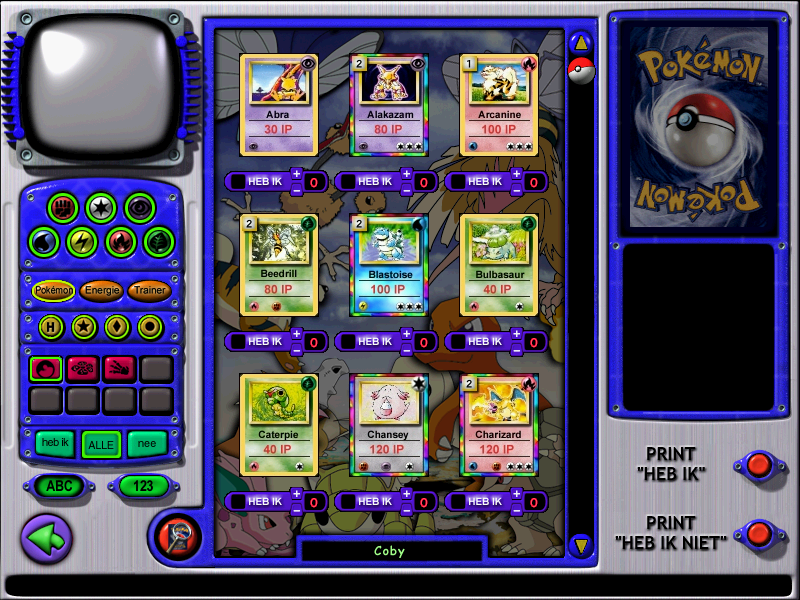
Both discs are hosted by Julie, a chatty, fully voiced card player who is at once your teacher and your only opponent. The original has ten narrated lessons, a Play mode that pits one of four 30-card Half Decks of Base Set and Jungle cards against Julie in a three-Prize match, and an Extras menu of quizzes, printable certificates, wallpapers and Pokémon League material. Version 2 turns the lessons into a fifteen-level ladder, adds seven full 60-card decks that bring in Fossil and Team Rocket cards, and gains Collect and Build modes for cataloguing a real collection and planning decks.
Play It! was Wizards of the Coast’s own way of turning fans of the anime and the Game Boy games into card players, and in North America it reached the shops a few weeks before the Game Boy Color’s Pokémon Trading Card Game. Its Fighting and Water decks are the very decks sold in the box beside the disc, and the certificates from its exams could be traded for points at the Pokémon League. Short, buggy and largely forgotten, it is still the first official version of the card game for PCs, more than a decade before Pokémon Trading Card Game Online took up the idea.
Every Pokémon Trainer has to start somewhere. And this CD-ROM is the easiest way for you to learn the Pokémon trading card game. Learn it well and practice hard enough, and you’ll become a Pokémon Master Trainer – maybe even the number-one Master Trainer in the world!
If you’ve played Pokémon Game Boy or watched the animated TV series, you’ll be surprised to discover how much you already know about the Pokémon trading card game. Even if you’re new to the world of Pokémon, you’ll have lots of fun learning – and playing – this adventure-filled trading card game.
So pop this disc into your computer… and get started training right now!
- Learn all about the Pokémon trading card game
- Play the game!
- Use the deckbuilder guide to build your own decks.
- Print playmats, counters and more!
— Official description (Version 2 box)
Quick Answers
The questions people ask about Pokémon Play It!, answered first and explained further down the page.
Was Pokémon Play It! sold on its own?
No. Both versions were free extras packed with physical card products. Version 1 came in the 2-Player CD-ROM Starter Set with two 30-card half decks, and Version 2 came in the Thunderstorm Gift Box (the Tempest Gift Box outside North America) with a 60-card Theme Deck, booster packs and a metal Pikachu coin. There is nothing to buy inside the game either. More →
Can you still play Pokémon Play It! in 2026?
Only with an original CD-ROM, as neither disc has ever been re-released or sold as a download. The game was built for Windows 95 and 98: Version 2 installs on 32-bit Windows XP if its setup program is run in Windows 95/98 compatibility mode, but it refuses Windows NT 4.0 and 2000 and crashes frequently on Windows 7 and 10. More →
Is Pokémon Play It! on Switch, Mac or mobile?
No. Both versions exist only as Windows CD-ROMs, and there was never a Mac, console or phone edition. For an official way to play the card game digitally today, look to Pokémon Trading Card Game Live, which The Pokémon Company runs on computers and mobile devices. More →
How do you unlock the Fire and Xtra decks in Version 1?
Only the Fighting and Water Half Decks are open at first. Type the word “fire” on the main menu and the hidden Fire and Xtra decks appear, both built around Fire-type Pokémon such as Charmander, Growlithe and Ponyta. Whichever of the three non-Fighting decks you pick, Julie answers with her Fighting Deck. More →
What is the difference between Play It! and Version 2?
Version 2 swaps the free-standing Play mode for a fifteen-level ladder of guided tutorials and challenges, adds seven full 60-card decks with Fossil and Team Rocket cards, and introduces Collect and Build modes. It also allows benching during setup from its tenth level, fixes Magmar’s Flamethrower and can mute Julie’s remarks. More →

How many opponents are there?
Just one. Julie, the game’s host, teaches every lesson and plays every match on both discs. In Version 1 her deck depends on yours; in Version 2 each tutorial and challenge level gives her a set deck, and in the Advanced Challenge she picks one of the Theme Decks at random, never yours and never Royalty. More →
Which cards are in the game?
Version 1’s four Half Decks use Base Set and Jungle cards and 16 different Pokémon, from Machop and Seel to Arcanine and Magmar. Version 2 adds Fossil and Team Rocket, and its seven 60-card decks feature around 50 species, with cards such as Dark Charizard, Zapdos, Gyarados and Nidoqueen. More →
Is there a sequel to Pokémon Play It!?
Pokémon Play It! Version 2, released in 2000, is the only follow-up, and Wizards of the Coast made no more Play It! discs before the card game passed to Pokémon USA in 2003. The idea of an official computer version returned in 2011 with Pokémon Trading Card Game Online, and its successor, Pokémon Trading Card Game Live, carries it on today. More →
Story & characters
Play It! has no plot as such, only a framing story told by its host. After the Wizards of the Coast, Fluid Entertainment and Pokémon Trading Card Game logos, Julie greets you as a fellow Pokémon Trainer and promises that together you will become the greatest Pokémon Masters the world has ever seen. As she speaks, her hand glows and a tiny Earth rises from it, spins in space and turns into a Poké Ball; then the scene cuts to two boys playing the card game at a table, one of them throwing his arms up in triumph. You then choose or create a username and join her.
Julie fills in her own story as the lessons go on, from the friends she has in the Pokémon world to her favourite cards. In Version 2 the framing becomes a ladder: she coaches you through the tutorial stages, then, once the opening tutorial battles are over, stops helping and plays to win, and you have to beat her at each level to climb towards the Advanced Challenge.
Characters
Julie
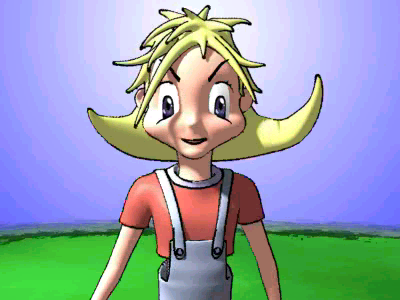
Julie narrates every lesson and plays every match on both discs, talking straight to you throughout. Water is her favourite card type and Poliwrath her favourite Pokémon, as she lets slip in the lesson on Energy cards. Her running commentary covers every move you make, which is why Version 2 adds an option to switch her remarks off.
Three more names from the Pokémon world turn up in Julie’s chatter, though none of them appears on screen:
- Professor Oak: Julie explains in the lesson on the playing field that she was in the middle of a game with Oak before he had to dash off, which is why she is free to take you on. His signature is on both Academy Entrance Exam certificates, giving the printouts an official air.
- Bill: In the lesson What’s a Trainer card?, Julie holds up the Bill card, which lets you draw two cards, and explains that it is named after her friend Bill, a Trainer too.
- Ash Ketchum: Julie mentions the anime’s hero in passing, a nod to the TV series that brought many of the disc’s young players to the hobby. The box text plays the same card, telling viewers of the show that they already know more about the card game than they think.
Versions, bundles & decks
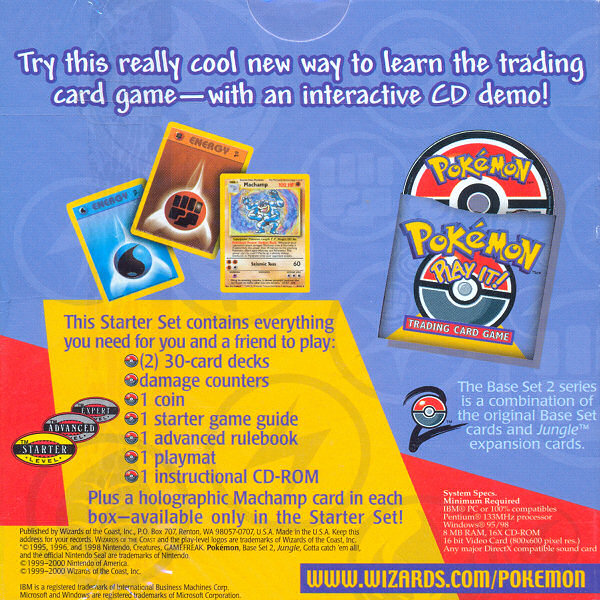
Neither version of Play It! was ever sold by itself. Each disc was a bonus inside a physical card product and was built around the cards in that box: Version 1 came with the 2-Player CD-ROM Starter Set and its Fighting and Water half decks, while Version 2 arrived in the Thunderstorm and Tempest Gift Boxes and swapped the half decks for seven full Theme Decks. Between them the two discs hold eleven decks and cards from Base Set, Jungle, Fossil and Team Rocket.
The boxes that carried the discs


Every deck on the two discs
Version 1 has four 30-card Half Decks, each with 14 basic Energy cards. Only Fighting and Water are open at first; type “fire” on the main menu and the Fire and Xtra decks appear. Version 2 adds seven 60-card Theme Decks, each running 24 to 28 basic Energy and drawing on Base Set, Jungle, Fossil and Team Rocket, with Dark Charizard, Dark Persian and Dark Raticate among the Team Rocket arrivals. Three of the Half Decks return in its Basic Challenges.
| Deck | Disc | Cards | Type | Key Pokémon | Notes |
|---|---|---|---|---|---|
| Fighting | Version 1 (and a Version 2 Basic Challenge) | 30 | Fighting | Machop, Machoke, Diglett | Available from the start; matches the boxed Fighting half deck |
| Water | Version 1 (and a Version 2 Basic Challenge) | 30 | Water | Goldeen, Seaking, Staryu, Seel | Available from the start; matches the boxed Water half deck |
| Fire | Version 1 (and a Version 2 Basic Challenge) | 30 | Fire | Charmander, Charmeleon, Ponyta | Unlocked by typing “fire” on the main menu |
| Xtra | Version 1 | 30 | Fire | Growlithe, Arcanine, Magmar | Unlocked with Fire; never used by Julie; on no Version 2 level |
| Electric Zap | Version 2 | 60 | Lightning | Pikachu, Electabuzz, Zapdos | Base Set Zapdos, with Team Rocket’s Voltorb and Dark Raticate |
| Flame On | Version 2 | 60 | Fire | Dark Charizard, Arcanine, Magmar | 28 Fire Energy, the most of any deck |
| Hit’Em Hard | Version 2 | 60 | Fighting | Hitmonchan, Machoke, Dark Persian | Includes Professor Oak |
| Poisonpowder | Version 2 | 60 | Grass | Gloom, Pinsir, Tangela, Koffing | Team Rocket’s Oddish, Ekans and Grimer |
| Psychic Dream | Version 2 | 60 | Psychic / Colorless | Wigglytuff, Dragonair, Jynx | Mixes Psychic and Colorless Pokémon; includes Scoop Up |
| Royalty | Version 2 | 60 | Grass | Nidoqueen, Nidorino, Weepinbell | Player-only; Julie never selects it |
| Wet and Wild | Version 2 | 60 | Water | Gyarados, Lapras, Golduck | Includes Professor Oak and Fossil cards |
From lessons to a ladder
| Pokémon Play It! | Version 2 | |
|---|---|---|
| Bundled with | 2-Player CD-ROM Starter Set | Thunderstorm Gift Box (North America) or Tempest Gift Box (elsewhere) |
| Released | 1999 (Europe), February 2000 (North America) | 2000 |
| Main menu | Learn, Play, Extras | Play, Help, Extras, Collect, Build |
| Teaching | 10 Learn lessons | 15-level Play ladder, plus 5 Help topics |
| Decks | 4 Half Decks of 30 cards | 7 Theme Decks of 60 cards, plus 3 Half Decks |
| Card sets | Base Set, Jungle | Base Set, Jungle, Fossil, Team Rocket |
| Benching during setup | Never allowed | Allowed from level 10, the Jigglypuff stage |
| Magmar’s Flamethrower | Discards no Energy | Discards Energy as printed |
| Julie’s commentary | Always on | Can be switched off |
| Collector tools | None | Collect (card album and checklist) and Build (deck builder) |
Gameplay & modes
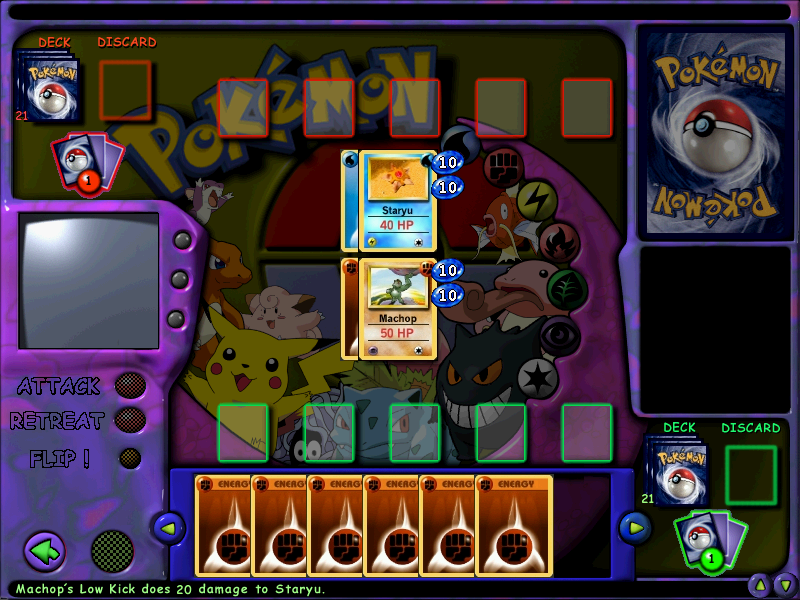
Matches are played with the mouse on a virtual playmat: the Active Pokémon sits in the Arena, damage counters are worth 10 HP apiece and coin flips are animated. Every Pokémon has its own cry when it is played into the Arena or evolved, some original to the games and others lifted from the anime, and Julie keeps up a running commentary on the action.
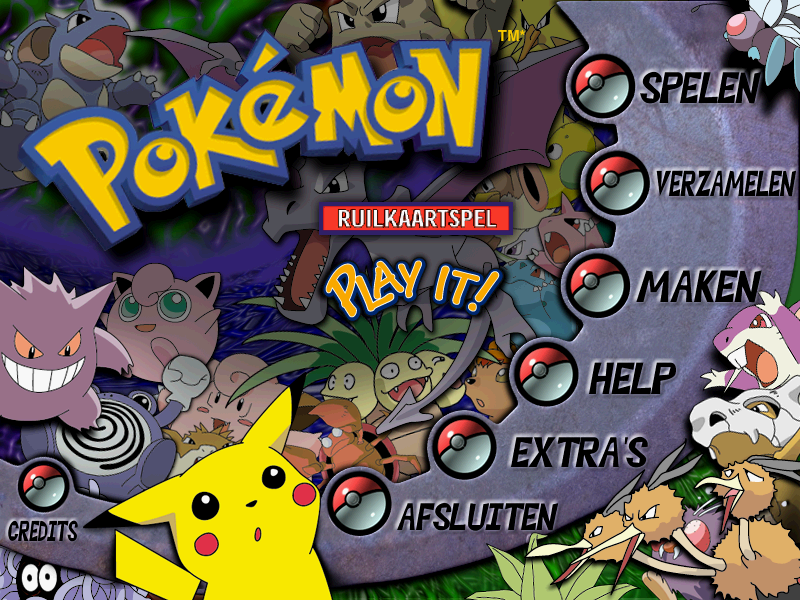
At the start Julie asks you to create or choose a username. Version 1 then opens on a three-way main menu: Learn holds the lessons, Play starts a real match and Extras gathers the quizzes and bonus material, with Julie suggesting newcomers try Learn first. Version 2 rebuilds the disc around a fifteen-level Play menu, moves the lessons to a smaller Help menu, keeps Extras and adds two collector’s tools, Collect and Build.
Version 1: Learn and Play

The ten lessons, in menu order:
- The first battle
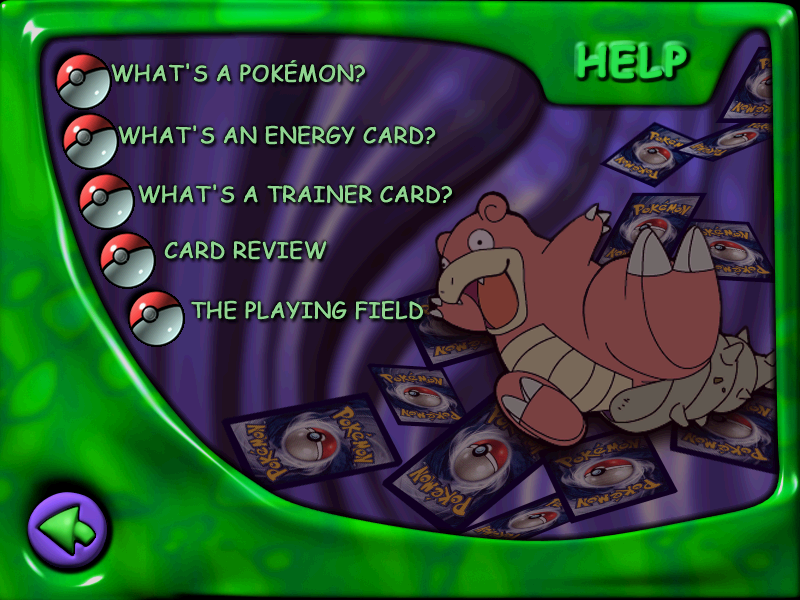
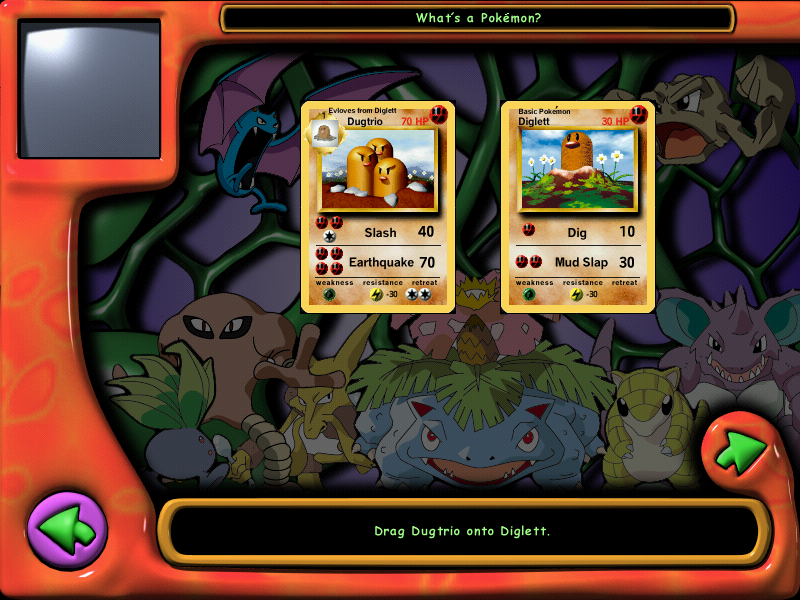
- What’s a Pokémon?
- What’s an Energy card?
- What’s a Trainer card?
- Card review
- The playing field
- How do I start a game?
- How do I retreat my Pokémon?
- How do I evolve my Pokémon?
- Advanced rules



Version 2: the ladder, Collect and Build
Extras: exams, certificates and wallpapers

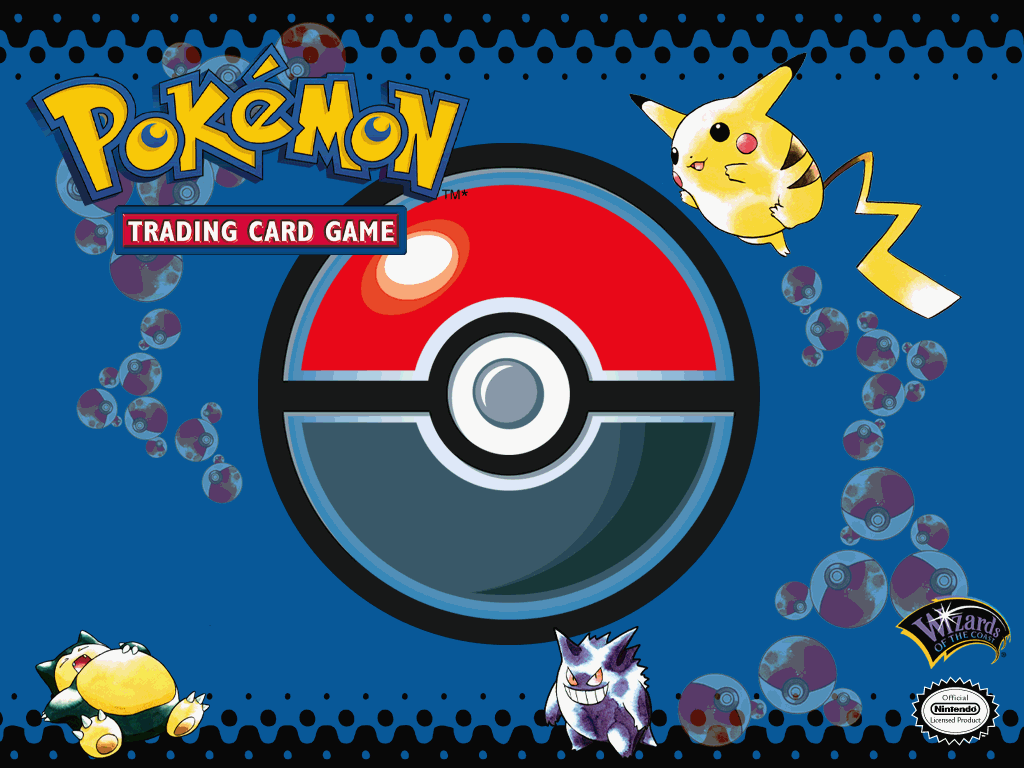
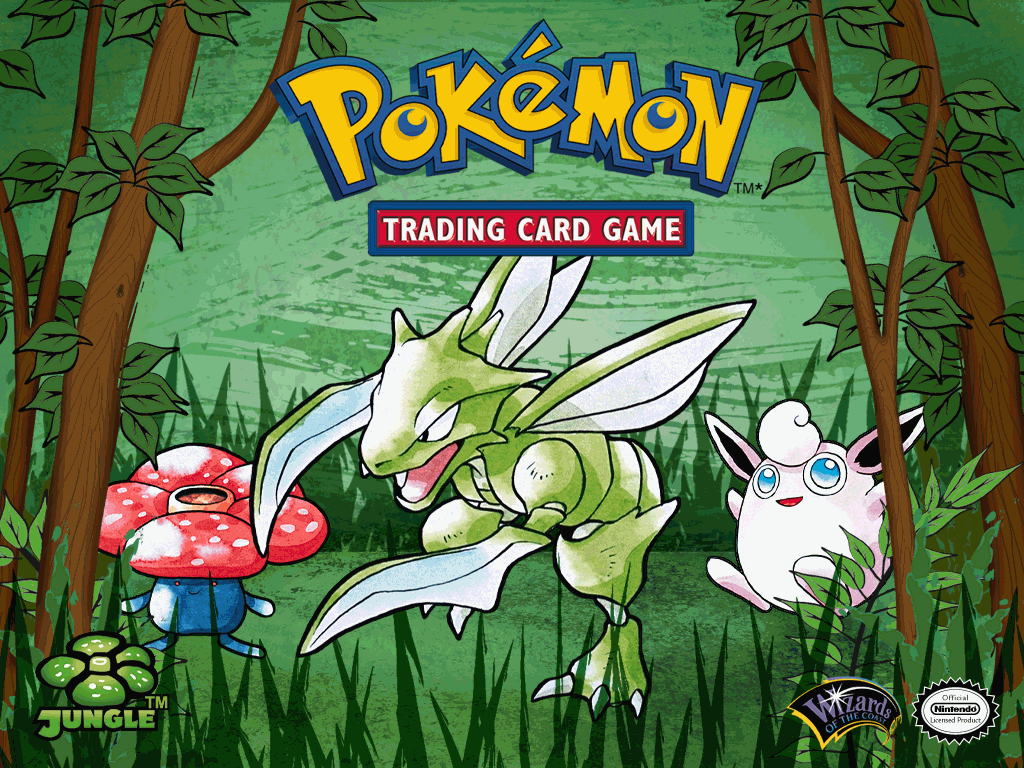
The four wallpapers show Pikachu, Gengar and Snorlax round a Poké Ball, a Jungle design with Scyther, Vileplume and Wigglytuff, Aerodactyl bursting out of a Fossil box, and a red Mewtwo design.


Julie’s matches
Julie is the only opponent on either disc. On the original she simply answers your choice of deck; Version 2 gives her a fixed deck on every tutorial and challenge level, and only the final Advanced Challenge leaves her choice to chance.
Version 1: Play mode
| Your deck | Julie’s reply |
|---|---|
| Fighting (Machop, Machoke, Diglett, Doduo, Meowth) | Water: Goldeen, Seaking, Staryu, Seel and Dratini, with Poké Ball, Bill, Gust of Wind and 14 Water Energy |
| Water (Goldeen, Seaking, Staryu, Seel, Dratini) | Fighting: the Machop line with Diglett, Doduo and Meowth, backed by Energy Removal, Pokédex and Switch |
| Fire (hidden at first) | Fighting |
| Xtra (hidden at first) | Fighting |
Version 2: the Play ladder
The named tutorial stages and every challenge on the ladder:
| Level | Julie plays | You play | What it teaches |
|---|---|---|---|
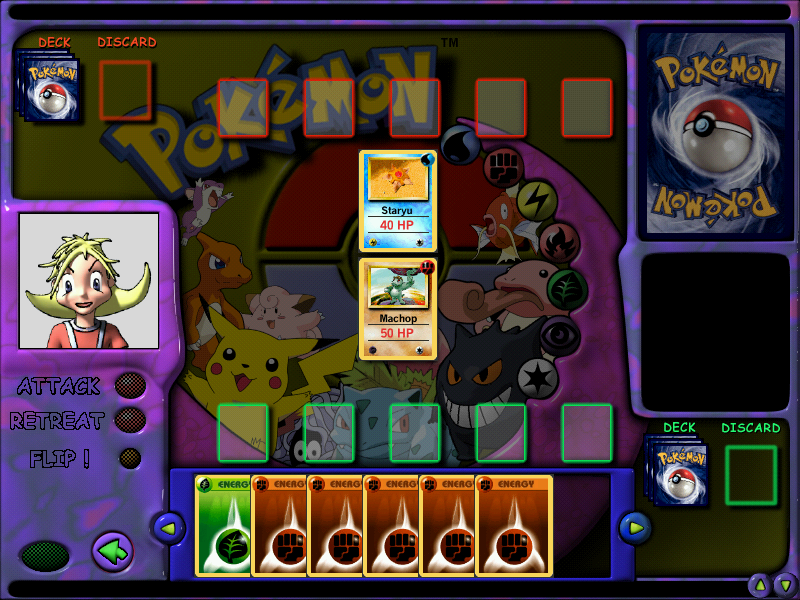
| Level 1: Machop stage | A lone Staryu with Water Energy | Machop and six Fighting Energy | Attacking: Staryu uses Slap twice before Machop’s Low Kick knocks it out, and the single Prize card is a Machoke |
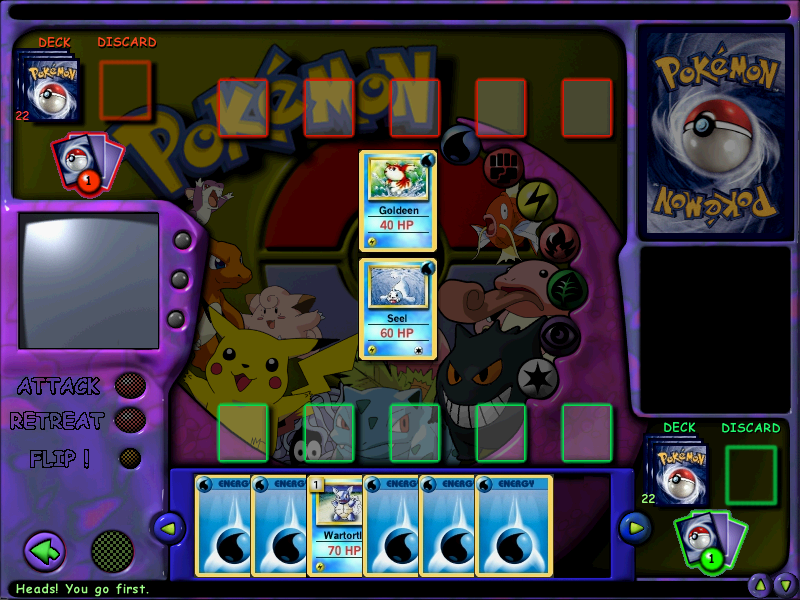
| Level 2: Seel stage | Goldeen | Seel, Wartortle and Water Energy | Setting up a game, then a one-Prize match: Seel’s Headbutt beats Goldeen’s Horn Attack in four hits, but dawdle for three turns and Julie wins. The Prize card is Squirtle |
| Level 4: Hitmonchan stage | Preset tutorial deck | Preset tutorial deck | When and how to pay a Retreat Cost to swap a damaged Active Pokémon for one on the Bench |
| Level 10: Jigglypuff stage | Preset tutorial deck | Preset tutorial deck | Julie announces a new rule: Pokémon may now go on the Bench before play starts |
| Basic Challenge | Water Half Deck | Fighting Half Deck | The original disc’s main pairing, and the two decks sold in the 2-Player CD-ROM Starter Set |
| Basic Challenge | Fighting Half Deck | Water Half Deck | The same decks with the sides swapped, so you pilot Goldeen, Staryu and Seel against the Machop line |
| Basic Challenge | Fighting Half Deck | Fire Half Deck | The original’s hidden Fire Deck, with Charmander, Charmeleon, Ponyta and Growlithe, joins the ladder |
| Final level: Advanced Challenge | A random Theme Deck: Electric Zap, Flame On, Hit’Em Hard, Poisonpowder, Psychic Dream or Wet and Wild, never the same as yours | Any of the seven Theme Decks, Royalty included | Full 60-card play with no help from Julie |


Pokémon & cards
There is nothing to catch in Play It!: its Pokémon are the cards of the day, each with its own cry. Version 1’s four Half Decks use 16 species, all on Base Set and Jungle cards, and the lessons add a few more, such as Dugtrio, Beedrill, Bulbasaur and Ivysaur. Version 2 widens the pool to Fossil and Team Rocket, and its seven Theme Decks bring around 50 species into play, Dark Pokémon among them.
The Half Deck Pokémon
All 16 Pokémon in Version 1’s Half Decks, with the deck each one belongs to:
 MachopFighting
 MachokeFighting
 DiglettFighting
 DoduoFighting
 MeowthFighting
 GoldeenWater
 SeakingWater
 StaryuWater
 SeelWater
 DratiniWater & Xtra
 CharmanderFire & Xtra
 CharmeleonFire
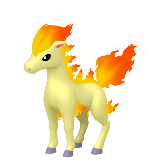 PonytaFire & Xtra
 GrowlitheFire & Xtra
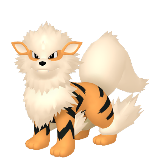 ArcanineXtra
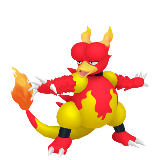 MagmarXtra
The Theme Deck Pokémon
One headline Pokémon from each of Version 2’s seven Theme Decks:
 ZapdosElectric Zap
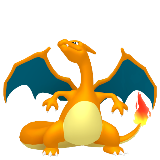 CharizardFlame On · as Dark Charizard
 HitmonchanHit’Em Hard
 GloomPoisonpowder
 WigglytuffPsychic Dream
 NidoqueenRoyalty
 GyaradosWet and Wild
Pokémon of note
A few more Pokémon with a part to play beyond their cards:
 PoliwrathJulie’s favourite Pokémon
 PikachuJulie’s Active Pokémon in the setup lesson
 DugtrioEvolved onto Diglett in the lessons
 BeedrillStar of the HP quiz
 JigglypuffLevel 10, where benching at setup begins
 TaurosBehind the crash bug
 MachampThe Starter Set’s bonus holo card
 VaporeonMisspelt in a Version 2 exam
Regional Variations
Play It! was a Western product from start to finish, and the differences between editions lie mostly in what came in the box:
- Version 1 came out in Europe in 1999, before its North American release in the 2-Player CD-ROM Starter Set in February 2000.
- The Thunderstorm (North America) and Tempest (elsewhere) Gift Boxes carry the same Version 2 disc and extras but different Theme Decks, and the printings differ too: Tempest’s Base Set cards are Base Set 2 prints, while Thunderstorm uses original Base Set cards.
- A Dutch edition of Version 2 is fully dubbed and built around Dutch cards. Its logo keeps the Pokémon Play It! name, its menu drops Version 2, and its voice-overs call the game Pokémon: Speel Het.
- The Team Rocket expansion was never printed in Dutch, so the Dutch Collect mode leaves that set out.
- Neither version was released in Japan or South Korea.
Glitches, exploits and oddities
A Flamethrower that costs nothing, a Tauros that can bring down the whole computer and a couple of rule slips:
Magmar’s Flamethrower

Base Set Magmar’s Flamethrower should make you discard an Energy card attached to Magmar. On the original disc it discards nothing, so the Xtra Deck’s Magmar can fire off its strongest attack turn after turn without ever paying for it, a real edge in a three-Prize match. Version 2 fixes it, and Flame On’s three Magmar discard Energy as printed.
No benching during setup
The printed rules let both players put Basic Pokémon on the Bench during setup, but Version 1 does not, so you have to wait for your first turn to bench anything and are left more exposed in the opening turns than the rules intend. Version 2 keeps the restriction for its first nine levels and only lifts it at the tenth, the Jigglypuff stage, where Julie presents it as a new rule.
The Tauros crash
The best-known bug in the Play It! games involves Tauros, from the Jungle expansion: if its card turns up in your deck or the computer’s, the game can shut down or freeze the whole computer. Tauros is in none of the original’s four Half Decks, but three of Version 2’s Theme Decks carry it: Electric Zap, Flame On and Hit’Em Hard.
A misplaced quiz hint
In Version 1’s What’s a Pokémon? lesson, the three-question Beedrill quiz asks where a card shows its HP. Answer wrongly and the hint highlights the Pokémon’s type in the top right-hand corner instead; Version 2 points to the HP correctly. The same lesson can also make Julie vanish, leaving an empty grey space on screen while her voice carries on.
Trivia & facts
- Play It! is the first Pokémon game to mention Ash Ketchum: Julie refers to him, although he never appears.
- Julie calls herself a Pokémon Trainer, yet she never trains a Pokémon; the card table is where she does her battling.
- Both discs open their teaching with the same battle: your Machop against Julie’s lone Staryu, settled by Low Kick.
- In Version 1’s first battle your hand includes a stray Grass Energy, which simply bounces back to your hand if you try to attach it to Machop. Version 2 deals you six Fighting Energy instead.
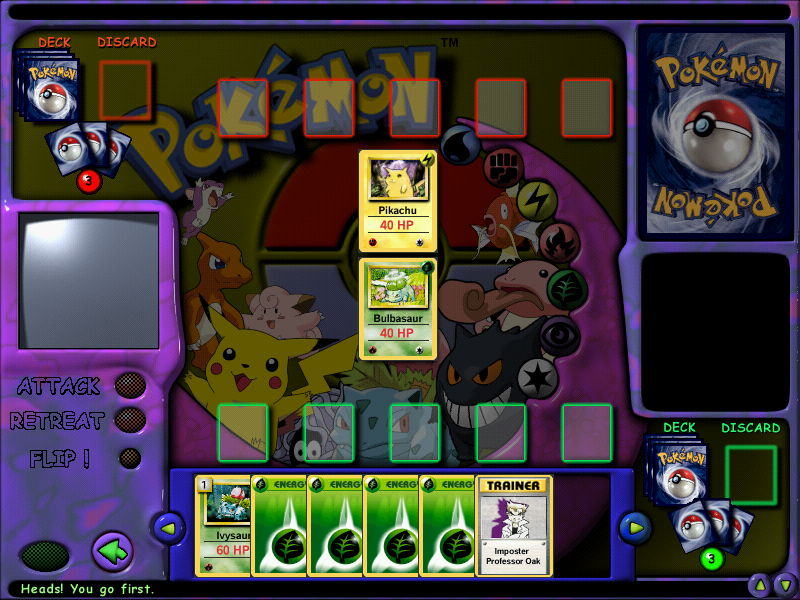
- Version 1’s setup lesson deals you an Impostor Professor Oak card alongside Bulbasaur and Ivysaur, while Julie starts with Pikachu as her Active Pokémon.
- The Bill card is one of the commonest on either disc: it is in three of the four original Half Decks and in all seven Version 2 Theme Decks.
- Flame On carries 28 Fire Energy, more basic Energy than any other deck in either version.
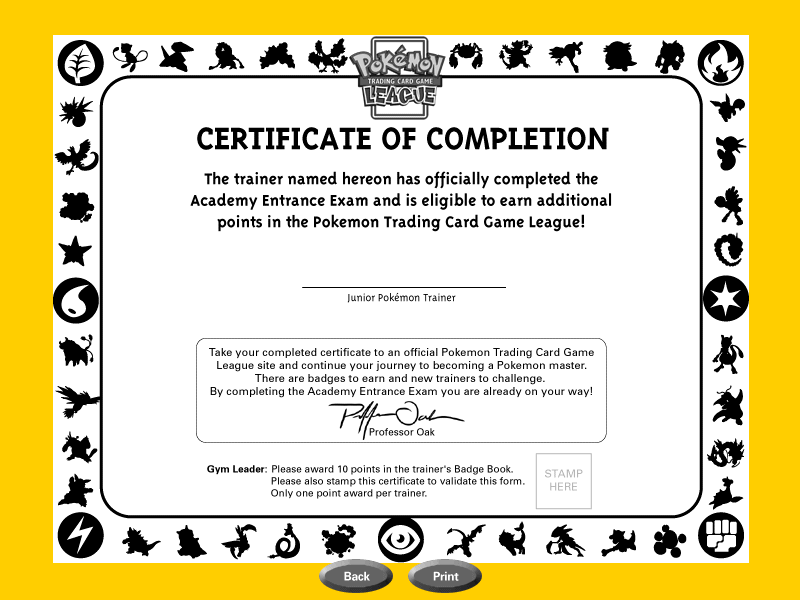
- Both Academy Entrance Exam certificates carry Professor Oak’s signature, and on both discs the 20-point certificate prints “20points” without a space.
-
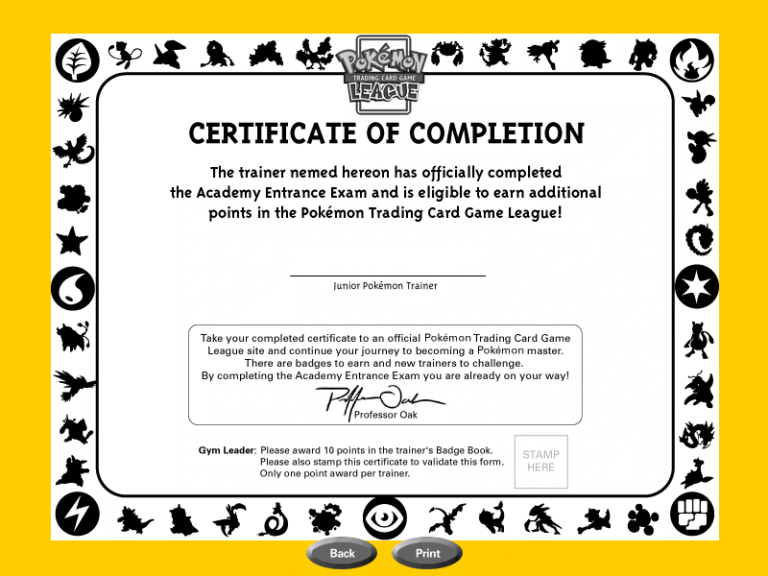
A Version 2 exam certificate. One of Version 2’s certificates misspells “named” as “nemed”.
-
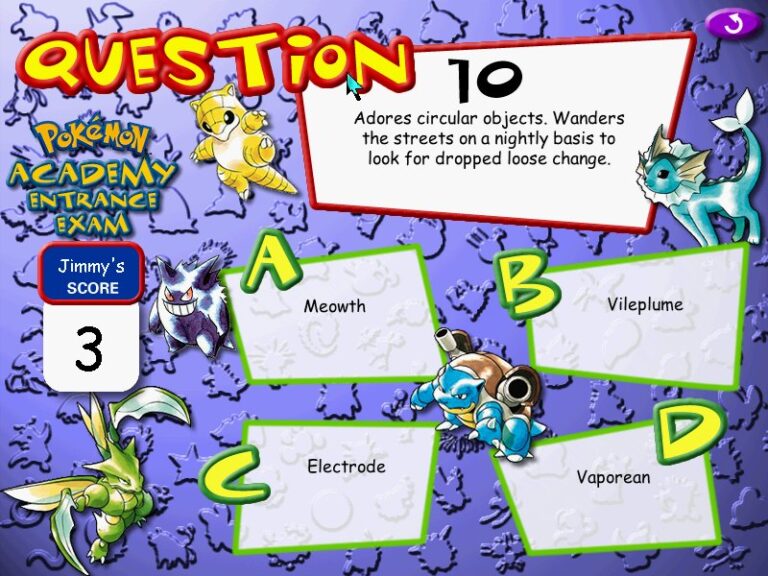
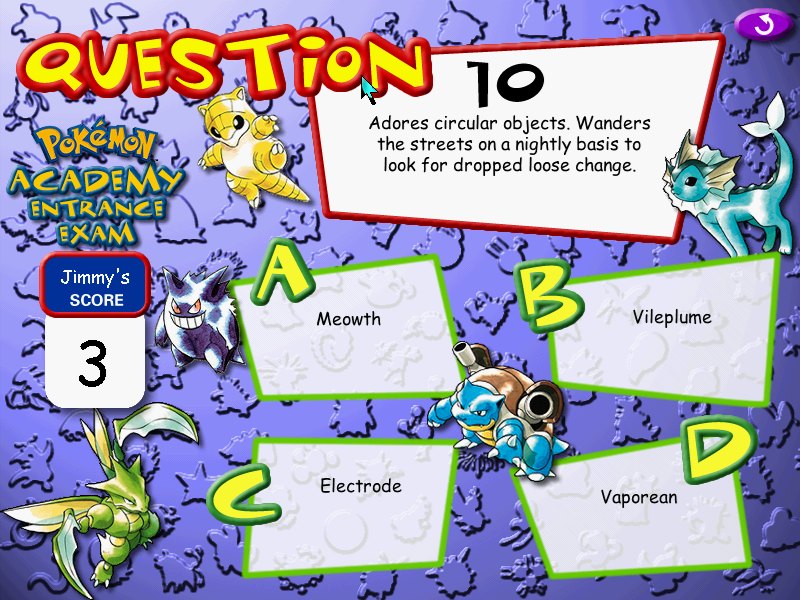
The question with ‘Vaporean’. One Version 2 exam question reads: “Adores circular objects. Wanders the streets on a nightly basis to look for dropped loose change.” The answer is Meowth, and one of the wrong options, Vaporeon, is spelt “Vaporean”.

Legacy
What came after
- Pokémon Play It! released in Europe – 1999. The first official PC version of the Pokémon Trading Card Game
- North American release in the 2-Player CD-ROM Starter Set – February 2000. A Base Set 2 product with Fighting and Water half decks and a holo Machamp
- Pokémon Trading Card Game reaches North America – April 2000. The Game Boy Color version of the card game follows the Play It! Starter Set into North American shops by a few weeks
- Pokémon Play It! Version 2 in the Thunderstorm Gift Box – 2000, between the Gym Heroes (August) and Gym Challenge (October) expansions. Adds the fifteen-level ladder, seven 60-card decks and Collect and Build modes
- Version 2 in the Tempest Gift Box – 2000. The European counterpart of the Thunderstorm box, with a different Theme Deck
- Dutch-dubbed edition of Version 2 – early 2000s. Voiced as Pokémon: Speel Het and built around Dutch cards, without the Team Rocket set
- Pokémon USA takes over the card game from Wizards of the Coast – 2003. Ends Wizards’ run of Pokémon products, leaving Version 2 as the last Play It! disc
- Pokémon Trading Card Game Online launches – 2011. The next official computer version of the card game, run by The Pokémon Company International
- Pokémon Trading Card Game Live succeeds the Online game – 2023. The current official way to play the card game digitally
Where to play it today
As of October 2026 the only way to play either disc is with an original CD-ROM, picked up second-hand or inside a sealed Starter Set or Gift Box; neither version has ever been sold as a download, and there is no Mac edition. The discs were built for Windows 95 and 98. Version 2 will install on 32-bit Windows XP once its setup program is set to Windows 95/98 compatibility mode, but it refuses Windows NT 4.0 and 2000 and crashes often on Windows 7 and 10. For an official way to play the card game on a screen today, the place to go is Pokémon TCG Live.
How it was made
Play It! was developed by Fluid Entertainment, a Californian studio that made licensed PC and Mac games for companies such as Hasbro, Disney, Mattel, The Learning Company and Berkeley Systems, on licences from Pokémon to Harry Potter and The Powerpuff Girls. Wizards of the Coast, which ran the Pokémon Trading Card Game outside Asia and had been bought by Hasbro in 1999, published it as a teaching aid for its starter products, and the disc opens with the Wizards of the Coast, Fluid Entertainment and Pokémon TCG logos.
Around 30 people are credited, in roles that include Julie’s character design, cards and effects, audio design and voice talent. The game’s sound runs on the Miles Sound System, and it asks for no more than a Pentium 133 with 16 MB of RAM, a 4x CD-ROM drive and a 16-bit display at 800×600 under Windows 95 or 98.
Play It! and the real card game

Sales & reviews
Sales & distribution
Neither disc was ever sold by itself, so there are no sales figures to quote: every copy went out free inside a Pokémon TCG product, Version 1 in the 2-Player CD-ROM Starter Set and Version 2 in the Thunderstorm and Tempest Gift Boxes, and no shipment numbers for those boxes are known. The discs were there to sell the card game, not the other way round.
- Freeinside card products, never sold alone
- 2discs: Play It! and Version 2
- 11decks across the two versions
- 15levels on Version 2’s Play ladder
Review scores
As a free extra rather than a boxed game, Play It! went all but unnoticed by the games press of 1999 and 2000, and the fullest verdict comes from a player writing years later. A 2007 reader review of Version 2 on HonestGamers called it “the most accurate simulation of the Pokemon Trading Card game” and found its look “soft and encouraging”.
The same review rated Version 2 ahead of both the original disc and the Game Boy Color game as a copy of the real thing, praising cards that look just like their printed versions, short but well-made attack animations and a run of more than ten unlockable battles, and it valued the printable checklist, the deck builder that saves your decks and the PDF rulebook. Against that, both discs have well-known rough edges: setup rules that forbid benching, the Magmar and Tauros bugs, a Royalty Deck the computer never touches and frequent crashes on modern versions of Windows.
Media & artwork
- Box art from Pokémon Play It! and Pokémon Play It! Version 2
- Pokémon TCG sets, cards and artwork in the TCG section
Further reading
More card games and PC games on the site: