  |
|
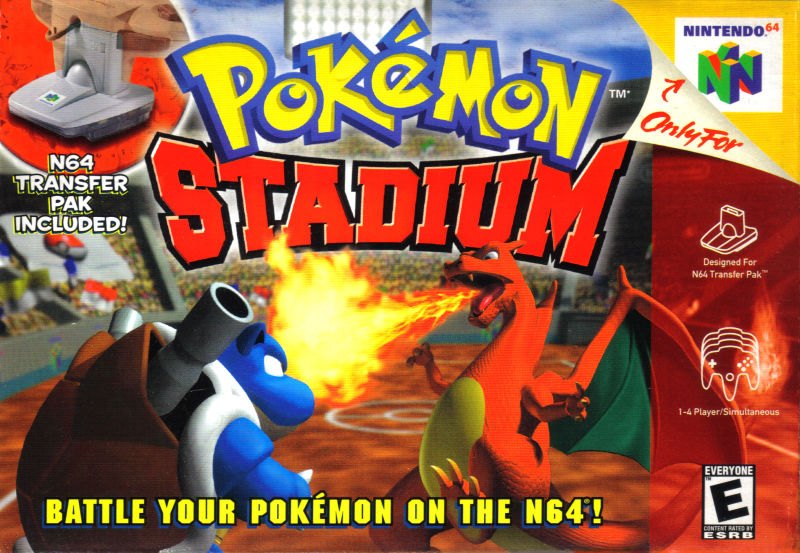
| Titles | Pokémon Stadium ポケモンスタジアム2 (Pokémon Stadium 2 in Japan) |
| Platform | Nintendo 64, with the N64 Transfer Pak (in the box in North America) |
| Developer | Nintendo EAD |
| Publisher | Nintendo |
| Director | Takao Shimizu |
| Producers | Kenji Miki · Tsunekazu Ishihara · Satoru Iwata · Shigeru Miyamoto |
| Music | Kenta Nagata · Hajime Wakai · Tōru Minegishi |
| Players | 1–4 |
| Genre | Turn-based battle / strategy |
| Pokémon | All 151 from Generation I, in 3D |
| Released | 30 April 1999 (Japan) · 6 March 2000 (North America) · 23 March 2000 (Australia) · 7 April 2000 (Europe) |
| Re-releases | Nintendo Switch Online + Expansion Pack, 12 April 2023 (no Transfer Pak features) |
| Rating | ESRB E · PEGI 3 · OFLC G8+ |
| Predecessor | Pokémon Stadium (Japan only, 1998) |
| Successor | Pokémon Stadium 2 (2000–01) |
| Sales | About 3.97 million |
Overview
 Released in Japan on 30 April 1999 (as Pokémon Stadium 2), in North America on 6 March 2000, in Australia on 23 March 2000 and in Europe on 7 April 2000, Pokémon Stadium for the Nintendo 64 was actually the sequel to an earlier Pokémon Stadium released only in Japan, which let just 40 of the 151 first-generation Pokémon battle (which explains the numbering difference between the regions).
Pokémon Stadium made the dreams of Pokémon players in the West come true at the time, bringing 3D Pokémon battles to their screens for the first time. The game was praised for its astonishing 3D modelling and animation of the Pokémon, their moves and abilities, yet it was somewhat disappointing in terms of sound, since many players expected unique Pokémon voices like those in the animated series instead of the generic cries. The game also marked the series’ debut in the strategy genre in the West, focusing mainly on battles and different play modes, such as the four Stadium Cups, the Gym Leader Castle, Versus battles and plenty of mini-games.
Since Pokémon Stadium didn’t offer the exploration of the RPGs, Nintendo smartly made up for it with the Transfer Pak, which links the game to the original Western Pokémon trilogy (Red, Blue and Yellow), letting players transfer the Pokémon they raised into Pokémon Stadium, whether to use them in battle or simply store them. In 2001, Pokémon Stadium 2 followed in the West (it came out in Japan in December 2000), featuring the second generation of Pokémon and linking to Gold, Silver and Crystal as well as the first three games.
Unlike the RPGs, Pokémon Stadium doesn’t have a story, as the goal of the game is to complete the Stadium Cups and the Gym Leader Castle – and then beat Mewtwo.
The ultimate Pokémon battle is about to begin…
At long last, all of your favorite Pokémon are ready to go head-to-head on the N64! Whether you’re battling a friend, a Gym Leader or a tournament contestant, you’re about to witness some of the most spectacular battle scenes in history! Select a team from a huge stable of “rental” battlers, or use the included N64 Transfer Pack to upload your own team from Pokémon Red, Blue or Yellow! This stadium is packed and ready to rock!
— Official description
Quick Answers
The questions people ask about Pokémon Stadium, answered first and explained further down the page.
How do you unlock Round 2 in Pokémon Stadium?
Clear every Stadium cup and the Gym Leader Castle, and Mewtwo’s silhouette appears over the Stadium. Beat the level 100 Mewtwo with up to six Pokémon of your own or Prime Cup rentals; the credits roll, the title screen changes and Round 2 opens. Press C-Right on the main menu to switch between Round 1 and Round 2. More →
How do you get a Pikachu that knows Surf in Pokémon Stadium?
Win the Master Ball division of the Prime Cup in Round 2 with a team taken straight from Red, Blue or Yellow cartridges, with no rentals or registered teams, that includes Pikachu. Continues are allowed but saving part-way is not, and Pikachu only has to be picked for the final battle. Surf then unlocks Pikachu’s Beach in Yellow. More →
Is Pokémon Stadium on Nintendo Switch Online?
Yes. It joined the Nintendo Switch Online + Expansion Pack library on 12 April 2023 in the Nintendo 64 app (now Nintendo 64 – Nintendo Classics), and it runs on Switch 2 as well. Online battles work, but Transfer Pak features do not, so there is no GB Tower and no importing Pokémon from Red, Blue or Yellow. More →
Why is Pokémon Stadium called Pokémon Stadium 2 in Japan?
Japan had an earlier Pokémon Stadium on 1 August 1998, a 64DD project moved to cartridge that let only 40 Pokémon battle. Its follow-up, with all 151 Pokémon, came out there on 30 April 1999 as Pokémon Stadium 2, and that is the game Nintendo released abroad in 2000 as plain Pokémon Stadium. More →
How do you unlock the Doduo and Dodrio GB Towers?
The GB Tower plays Pokémon Red, Blue or Yellow on the television through the Transfer Pak. Win the Poké Cup or the Prime Cup in Round 1 for the Doduo GB Tower, which runs the Game Boy game at double speed; win both cups for the Dodrio GB Tower, which runs at triple speed. More →
What mini-games are in Pokémon Stadium’s Kids Club?
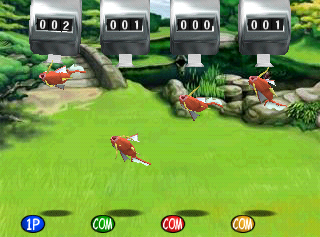
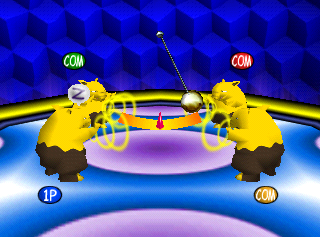
There are nine: Clefairy Says, Dig! Dig! Dig!, Ekans’ Hoop Hurl, Magikarp’s Splash, Rock Harden, Run, Rattata, Run, Snore War, Sushi-Go-Round and Thundering Dynamo. Each is for four competitors, with the computer filling empty places on Easy, Normal or Hard, and a hidden Hyper level unlocks after five wins in a row on Hard. More →
Game Modes

Pokémon Stadium comes with a wide variety of modes, some of which have to be unlocked by completing parts of the game.
- Battle Now: Before entering the Stadium, the player can play casual matches against the AI or another player, each side being given one of two preset teams of rental Pokémon at random.
- Event Battle: Another casual player-versus-player mode, which lets players set different rules for their matches. Both players need one of the trilogy games plugged into their Transfer Pak, since the Pokémon party in each Game Boy game is the team used in battle.
- Stadium: The main game mode, offering four player-versus-AI cups, each with its own difficulty, set of rules and opponents (eight trainers per cup or division). The Stadium also comes in a harder Round 2, which is unlocked by defeating Mewtwo.
- Pika Cup: The easy Stadium Cup, where every Pokémon except Mew and Mewtwo can be used. Pokémon must be between levels 15 and 20, and the three chosen cannot total more than 50.
- Petit Cup: The intermediate Stadium Cup, where only 45 Pokémon can be used – those in their lowest evolutionary stage that are no taller than 6′7″ (2 metres) and no heavier than 44.1 lb (20 kilograms), at levels 25 to 30, with a maximum total of 80.
- Poké Cup: This Stadium Cup has four difficulties of its own, each named after a Poké Ball (Poké Ball, Great Ball, Ultra Ball and Master Ball divisions), and to unlock a harder division the player has to defeat all the trainers in the previous one. Only Pokémon between levels 50 and 55 can be used, excluding Mew and Mewtwo, with a team level limit of 155.
- Prime Cup: Like the Poké Cup, this Stadium Cup comes in four divisions (Poké Ball, Great Ball, Ultra Ball and Master Ball), but it puts no restrictions on the Pokémon that can be used, their level or the team level, so the legendaries Mew and Mewtwo can be used. All the Pokémon the player faces in this cup are level 100.

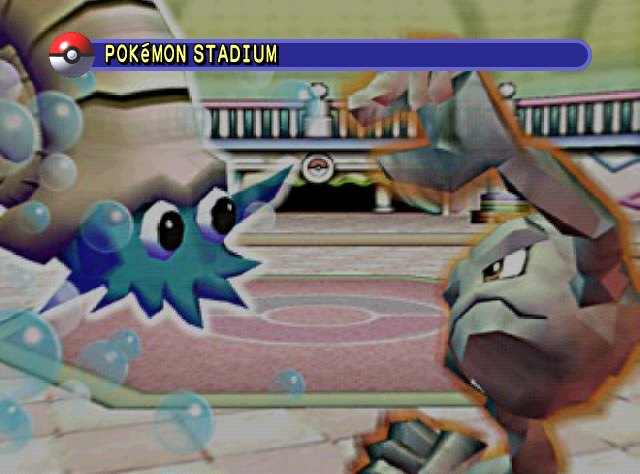
- Free Battle: Another casual battle mode, following the rules of the different Stadium Cups, in which a player can face the AI or up to three other players. Players can also team up with each other.
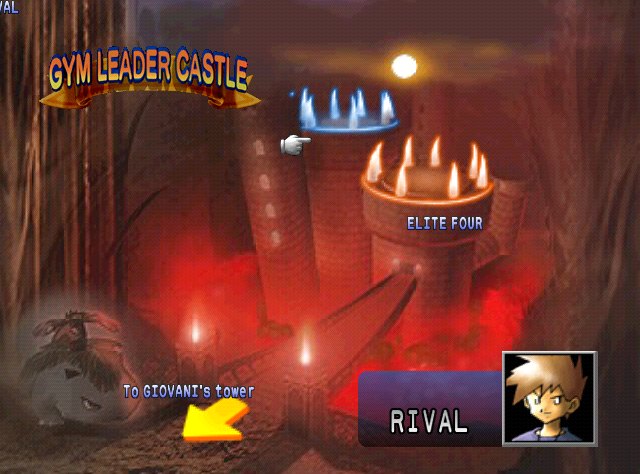
- Gym Leader Castle: In this mode the player faces the Gym Leaders of the Kanto region, battling three trainers in each Gym before the Gym Leader. Once all eight are defeated, the player can take on the Elite Four and then the Champion, who is also his rival (see below).
- Kids Club: A series of nine mini-games that can be played against the AI on four difficulty levels (the fourth, Hyper, is hidden) or against other players.
- Vs. Mewtwo and Round 2: Once every Stadium Cup and the Gym Leader Castle are cleared, the player faces Mewtwo. Defeating Mewtwo unlocks Round 2, a harder replay of the whole game.
- Hall of Fame: Whenever the player wins a Stadium Cup, the Pokémon team used is recorded in the Hall of Fame, each Pokémon with the cups it has won.
- Gallery: This mode lets the player take photos of the Pokémon in the game, which could be printed as stickers at Pokémon Snap Station kiosks. This mode was only included in the North American version of the game.
Kids Club mini-games




In depth: the fine print

The Gym Leader Castle

The Gym Leader Castle is Pokémon Stadium’s take on the Kanto adventure: eight Gyms of three trainers plus the Leader, then the Elite Four and the rival in one long run – 37 battles in all. Each Leader brings a team of six from which three are chosen, and the line-ups change completely in Round 2. Beating the rival sends a random prize Pokémon to the Pokémon Lab.
| Trainer | Gym | Type | Round 1 team | Round 2 team |
|---|---|---|---|---|
| Brock | Pewter Gym | Rock | Onix, Graveler, Omanyte, Kabuto, Cubone, Vulpix | Onix, Golem, Omastar, Dugtrio, Golbat, Ninetales |
| Misty | Cerulean Gym | Water | Starmie, Blastoise, Staryu, Horsea, Psyduck, Seel | Starmie, Blastoise, Seadra, Dewgong, Exeggutor, Dugtrio |
| Lt. Surge | Vermilion Gym | Electric | Raichu, Pikachu, Voltorb, Electrode, Magnemite, Magneton | Raichu, Electabuzz, Electrode, Lickitung, Tangela, Poliwrath |
| Erika | Celadon Gym | Grass | Vileplume, Gloom, Victreebel, Weepinbell, Tangela, Exeggcute | Vileplume, Victreebel, Tangela, Exeggutor, Dewgong, Clefable |
| Koga | Fuchsia Gym | Poison | Venomoth, Venonat, Muk, Weezing, Nidorino, Nidorina | Includes Venomoth, Muk, Weezing, Hypno and Tangela |
| Sabrina | Saffron Gym | Psychic | Alakazam, Kadabra, Hypno, Exeggutor, Mr. Mime, Jynx | Alakazam, Hypno, Exeggutor, Mr. Mime, Snorlax, Wigglytuff |
| Blaine | Cinnabar Gym | Fire | Includes Charizard, Arcanine, Magmar and Rapidash | Includes Charizard, Magmar, Rapidash, Chansey, Tangela and Parasect |
| Giovanni | Viridian Gym | Ground | Nidoking, Nidoqueen, Rhydon, Dugtrio, Persian, Tauros | Nidoking, Nidoqueen, Persian, Tauros, Gengar, Moltres |
| Lorelei | Elite Four | Ice | Dewgong, Cloyster, Jynx, Lapras, Slowbro, Articuno | Cloyster, Articuno, Starmie, Omastar, Wigglytuff, Exeggutor |
| Bruno | Elite Four | Fighting | Machamp, Hitmonlee, Hitmonchan, Onix, Golem, Rhydon | Machamp, Hitmonlee, Rhydon, Slowbro, Muk, Clefable |
| Agatha | Elite Four | Ghost | Gengar, Haunter, Golbat, Arbok, Muk, Venusaur | Gengar, Venusaur, Arbok, Alakazam, Gyarados, Jynx |
| Lance | Elite Four | Dragon | Dragonair, Gyarados, Aerodactyl, Charizard, Lapras, Kangaskhan | Charizard, Lapras, Kangaskhan, Arcanine, Electabuzz, Snorlax |
| Rival | Champion | Mixed | Exeggutor, Slowbro, Ninetales, Clefable, Electabuzz, Pinsir (no Game Pak) | Same Pokémon, new movesets |

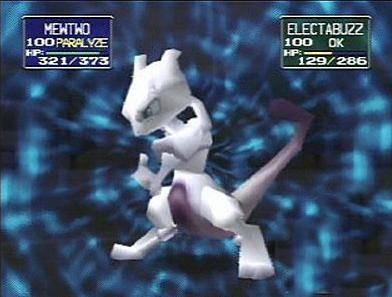
The final challenger: Appears once every cup and the Gym Leader Castle are cleared. Mewtwo fights alone against up to six of your Pokémon under Anything Goes-style rules. Mewtwo is level 100 with Psychic, Blizzard, Thunderbolt and Rest.
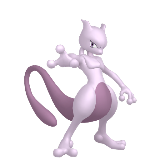 MewtwoLevel 100
 MewRound 2 rental
 PsyduckHall of Fame prize
 EeveeCastle prize
 PikachuSurfing reward
Integration with Other Titles

The Transfer Pak was the most prominent feature of Pokémon Stadium. It linked the game to the earlier Red, Blue and Yellow games, giving players access to new features like the GB Tower and the Pokémon Lab:
- GB Tower: This lets players play the compatible Pokémon games on the television – and, once the Doduo and Dodrio GB Towers are unlocked, at double or triple speed.
- Pokémon Lab: The most important feature the Transfer Pak offers. The Lab PC lets the player browse the boxes in the linked Pokémon game, organise their Pokémon and transfer them to Pokémon Stadium. It also provides twelve extra boxes that the player can use to store surplus Pokémon from the Game Boy games. In the Pokémon Lab, Pokémon can be traded if different games are inserted in the Transfer Paks of two controllers. Furthermore, there’s a Pokédex that players can use to see all their Pokémon in 3D, with all the relevant information.

Regional Variations
Japan’s version came first, more than ten months before the West’s, and the two differ in a few ways:
- In Japan the game is Pokémon Stadium 2, as it followed the 1998 Japan-only Pokémon Stadium; elsewhere it was released as Pokémon Stadium.
- The Japanese version has six Stadium cups, including Nintendo Cup ‘97, ‘98 and ‘99 tournaments. Western versions have four, with the Nintendo Cups replaced by a single Poké Cup based on Colosseum 2 in Pokémon Yellow.
- The Gallery mode exists only in the North American version, which moves the Options icon to make room for it on the main menu; Japanese and European versions have no Gallery.
- Only Western versions offer a Surfing Pikachu reward, through the Round 2 Prime Cup.
- Up to 12 teams can be registered in Japanese, but only 10 in English. The Lab’s storage is split into 8 boxes of 30 in Japan and 12 boxes of 20 in English, 240 spaces either way.
- The English version’s Kids Club voices were redone to match the English dub of the anime, and the Clefairy in Clefairy Says sing rather than repeat a sound effect. Western versions also play Pikachu’s voice at start-up instead of the human voices heard in the Japanese release.
- Trainer class and character names were shortened to fit a seven-letter limit in English, giving names such as Surge, Giovani, Lad, Cool♂ and Cool♀.
- Version 1.1 of the English release recoloured Jynx’s black face purple, and the PAL versions’ opening theme uses slightly different instruments from the NTSC versions.


Left in the data
- An animation of two Butterfree carrying a banner sits unused among the main menu graphics; it may once have shown location names, which the finished menu writes on clouds instead.
- CPU trainer graphics for the Japanese version’s Nintendo Cup ‘98 tournament remain in the Western game’s data even though that cup was removed.
- A Pokédex entry for an index number 152 exists in the data but never appears in the game.
- The move data lists Acid as a legal move for Diglett, which never learned it in any released game.
- A debug display that shows CPU, RCP and memory usage as meters can be switched on with cheat codes, alongside leftover debug text for the GB Tower, sound engine and battle system.
Glitches, exploits and oddities
A few quirks, most of them caused by moving Pokémon between the Game Boy and the Nintendo 64:
Magnemite type display glitch
Pokémon Stadium 2 records Magnemite and Magneton as Electric/Steel when it saves a Generation I cartridge through its Lab. If that cartridge is then used in Pokémon Stadium, the first game has no graphic for the Steel type, which did not exist in Generation I, and falls through to the next type in its list. The registration screen therefore shows the pair as Electric/Fire. The error is purely cosmetic: in battle they still behave as pure Electric types.
Nickname space glitch
When the Pokémon Lab converts text back into the Generation I character set, it leaves the space character unconverted. The Game Boy games read that value as the end of a name, so any Pokémon whose nickname contains a space loses everything after the space once the cartridge is saved through the Lab and played on a Game Boy. Early North American revisions are affected, and a later revision fixes the conversion, restoring the lost characters when the cartridge is saved through its Lab again.
Negative HP display
Glitches in Red, Blue and Yellow can push a Pokémon’s hit points below zero. The Game Boy games store HP as an unsigned number, so a negative value turns into an enormous one. When such a Pokémon is brought into Pokémon Stadium, the game reads the stored number and shows it in full, so the battle screen can display readings such as 64569 HP, far beyond any legitimate maximum.
Replacing HM moves
Generation I gives players no way to forget an HM move once it has been learned; the Move Deleter only arrived in Generation II. Pokémon Stadium makes an exception: if a Pokémon already knows four HM moves, a TM taught to it in Stadium is allowed to overwrite one of them. It is the only way in Generation I to remove an HM from a Pokémon, useful for a team member left carrying four field moves.
Videos & media
Check out these Pokémon Stadium videos: a TV commercial, the intro and all the Kids Club mini-games.
A US TV commercial for Pokémon Stadium.
The intro to Pokémon Stadium on the N64.
All the mini-games in Pokémon Stadium (video: HometownGuitar).
Trivia & facts
- When transferred to Pokémon Stadium, the starter Pikachu from Pokémon Yellow says its name, as in the anime (voiced by Ikue Otani), instead of using a generic cry like the rest of the Pokémon.
- Pokémon Stadium was the first Pokémon game that allowed more than two players to battle at the same time.
- A new title screen is unlocked after clearing the Gym Leader Castle and the Master Ball division of the Prime Cup.
- Finishing the Poké Cup or the Prime Cup unlocks the Doduo GB Tower, an enhanced version of the GB Tower that runs the linked games at 2× speed. Completing both unlocks the Dodrio GB Tower, which runs them at 3× speed.
- Electabuzz’s model has six digits on each hand – five fingers and a thumb.
- Nicknamed Pokémon get a slightly different colouring, worked out from the nickname, Original Trainer and ID number – and some of the trainers show their nicknamed Pokémon off.
- Winning the Master Ball division of the Prime Cup in Round 2 with a team brought straight from the Game Boy games, including Pikachu, teaches it Surf – which unlocks Pikachu’s Beach in Yellow.
Further trivia
- Pokémon Stadium was the first home console game in which every Pokémon of its generation could be used in battle.
- Team Rocket’s Pokémon have numbers in their nicknames, something the handheld games did not allow until Generation III.
- The Elite Four’s VS portraits resemble their artwork from the 1999 board game Pokémon Master Trainer, while the Gym Leaders’ portraits follow Ken Sugimori’s headshots and Blaine’s comes from the Red and Green instruction manual.
- Gym Leader Castle prize Pokémon taken into Gold, Silver or Crystal hold a Normal Box (Round 1) or Gorgeous Box (Round 2), which open into Silver and Gold Trophy room decorations.
- A February 1999 FAQ on Pokémon.com said there were no plans to release the first Japanese Pokémon Stadium in America.
- The instruction manual mixes up the third and fourth players’ colours for four-player battles; the Pokémon Stadium 2 manual has them the right way round.
- Thundering Dynamo’s secret Hyper difficulty is almost impossible on modern flat-screen televisions, because display lag eats into its tight timing.
Legacy
What came after
- Pokémon Stadium (Japan only) released – 1 August 1998. The predecessor, with 40 battle-ready Pokémon and the Transfer Pak bundled.
- Pokémon Stadium 2 released in Japan – 30 April 1999. The game later sold abroad as Pokémon Stadium, now with all 151 Pokémon.
- North American release – 6 March 2000. Packed with the N64 Transfer Pak; passed a million sales within a month.
- Australian release – 23 March 2000
- European release – 7 April 2000. Released without the Gallery mode.
- Pokémon Stadium Kin Gin released in Japan – 14 December 2000. The successor, released in North America on 26 March 2001 as Pokémon Stadium 2.
- Player’s Choice reissue in North America – 26 December 2000. Budget-priced reissue.
- Nintendo Switch Online announcement – 13 September 2022. Revealed in a Nintendo Direct for the Expansion Pack.
- Nintendo Switch Online + Expansion Pack release – 12 April 2023. Nintendo 64 app, now Nintendo 64 – Nintendo Classics; online play but no Transfer Pak features.
- Nintendo Classics release in Taiwan – 9 September 2025
Where to play it today
As of October 2026 the easiest way to play is Nintendo Switch Online + Expansion Pack, where Pokémon Stadium sits in the Nintendo 64 – Nintendo Classics app on Switch and Switch 2 with online battles. That version cannot connect to Game Boy games, so the GB Tower and team transfers are missing. The full experience needs a Nintendo 64, a Transfer Pak and original Red, Blue or Yellow cartridges. It has never been on Virtual Console.

How it was made
Pokémon Stadium was developed by Nintendo EAD, with Takao Shimizu directing and Kenji Miki, Tsunekazu Ishihara, Satoru Iwata and Shigeru Miyamoto producing. It grew out of the Japanese Pokémon Stadium of August 1998, first planned as a 64DD launch title for March 1998 and then moved to a cartridge that let only 40 Pokémon battle; a 64DD expansion disk meant to add the rest was dropped. Iwata, then president of HAL Laboratory, had analysed the Red and Green battle code and ported it to the Nintendo 64 in about a week, a feat that later left Game Freak’s Shigeki Morimoto amazed. A follow-up was announced in the December 1998 issue of The 64Dream and launched in Japan on 30 April 1999 with all 151 Pokémon. The Western release added the Gallery, an English announcer and Ikue Otani’s voice for Yellow’s Pikachu.
Pokémon Stadium elsewhere
Sales & reviews
Sales figures
As one of the N64’s best-selling games, Pokémon Stadium sold over a million copies in Japan within seven months of release, and in North America it passed a million within about a month and became the region’s best-selling console game of 2000. Sales kept growing, reaching nearly 4 million copies, of which 3.16 million were sold in the USA alone – enough to enter the US Platinum Videogame Chart.
- 3.97mworldwide
- 3.16mUnited States
- 1.37mJapan by Dec 1999
- No. 1N. American console game, 2000
Review scores
Critics were split between those praising the game’s groundbreaking graphics and gameplay and those criticising the sound. Despite that, Pokémon Stadium still managed high scores from many gaming websites and critics.
- IGN gave the game a score of 8.2/10, and Nintendo Power was also pretty impressed, scoring it 8.8/10 – unlike GameSpot, which graded the game 5.7/10, showing its disappointment with the sound: “The effects for projectile and other magic-style attacks are done well. The sound leaves a lot to be desired. Tossing in Pokemon voices from the TV show seems like a real no-brainer here, but alas, there is none to be found. An announcer gives the play-by-play, but his speech is very limited, and you’ll be hearing the same few phrases repeatedly. In addition, the voice and soundtrack are a little low on the frequency scale, making everything sound a little tinny and muffled.”
Critics were won over by the presentation: each of the 151 Pokémon had its own 3D model and battle animations, and the special effects for beam and elemental attacks drew praise. Many saw the Transfer Pak as the real selling point, since watching a team raised on the Game Boy fight on a television, or playing Red and Blue on the big screen, had obvious appeal for fans. The sound was the most common complaint, with GameSpot calling it tinny and muffled and regretting the lack of voices from the anime, while the announcer’s limited lines wore thin. Reviewers also noted that there was little to do without a cartridge and no story, so scores ranged from mediocre to very good. Japan’s Famitsu was warmer, awarding 33 out of 40.
Awards and honours:
Media & artwork
- Official artwork gallery from Pokémon Stadium – artwork of prominent Pokémon models
- Box art from Pokémon Stadium, including several regional variations
- Screenshots from Pokémon Stadium
Further reading
More Nintendo 64 Pokémon games on the site: